Truck accident firms can describe similar services while offering different levels of investigation and client support. Ask what is included in the engagement, which work may be outsourced and who would explain technical findings. The practical scope matters as much as the name on the advertisement.
The decision this article helps you make
Compare written case-management plans. Look for an identified lead attorney, a method of approving specialist work and a clear process for keeping you informed when new evidence changes the assessment.
Compare the investigation plan
Write a factual account of the collision while keeping uncertainties visible. Record the location, vehicles involved, available photographs and the organisations that have contacted you. Tell the legal team which documents already exist and which you do not have. Ask what evidence may need prompt professional attention; do not attempt to obtain private company records or enter an unsafe location yourself.
Identify who would do the specialist work
Ask a prospective firm how it would assess the vehicle operator, the circumstances of the journey and any other potentially relevant parties. A useful answer explains the investigation it would undertake, rather than assuming responsibility before examining evidence. If outside reconstruction or technical expertise might be needed, ask who would select the expert, approve the expense and explain the conclusions to you.
Separate the legal fee from investigation expenses
Two proposals with the same headline charging arrangement can still allocate investigation costs differently. Request an explanation of record retrieval, expert work and other spending that the team anticipates. Ask which expenses need your approval and how you would be kept informed as the case develops. Any illustration should identify assumed figures rather than presenting a generic settlement amount as likely.
Check communication and insurer coordination
Ask who would handle insurer correspondence and what information the firm needs from you before doing so. Preserve original communications and avoid treating an informal conversation as a complete settlement explanation. Find out how the team would coordinate injury evidence with the practical effects on work and daily life. Your comparison should favour an understandable case plan and clear responsibility for updates, not simply an impressive list of past results from unrelated collisions.
Examine what the package actually includes
Translate every broad description into an observable deliverable. Words such as comprehensive, premium and fully managed are not a substitute for an explanation of what the organisation will do. Ask for the tasks, the responsible people, the expected output and any conditions that limit delivery. The objective is to make the offer specific enough that you can recognise both completion and an omission.
Look carefully at the boundary between the main provider and third parties. A package may depend on another professional, a separate supplier or a product with its own terms. Ask who selects that third party, who receives the invoice and who responds if something goes wrong. Identify which commitments belong in your main agreement and which require separate confirmation. Do not assume that a referral automatically includes responsibility for the referred service.
Then check how changes are handled. Ask whether additional work needs your approval, how its price would be disclosed and what happens if you decline. A package can still be useful when it has exclusions, provided those exclusions are understandable and compatible with your needs. Compare the proposed scope against your own requirements rather than rewarding the longest feature list. Pay particular attention to the part of the service you would find hardest to replace yourself.
Apply the comparison to your location
Use the state relevant to your situation when checking a provider’s qualifications and the terms of an offer. A national advertisement does not establish that the advertised service is available on the same terms where you live. Record the legal name of the organisation you would contract with, the office responsible for delivery and the date of its proposal. Ask which state-specific conditions affect your comparison. Keep personal identifiers out of initial comparison emails; use a verified secure channel when supporting documents are actually needed.
Questions to put to your shortlist
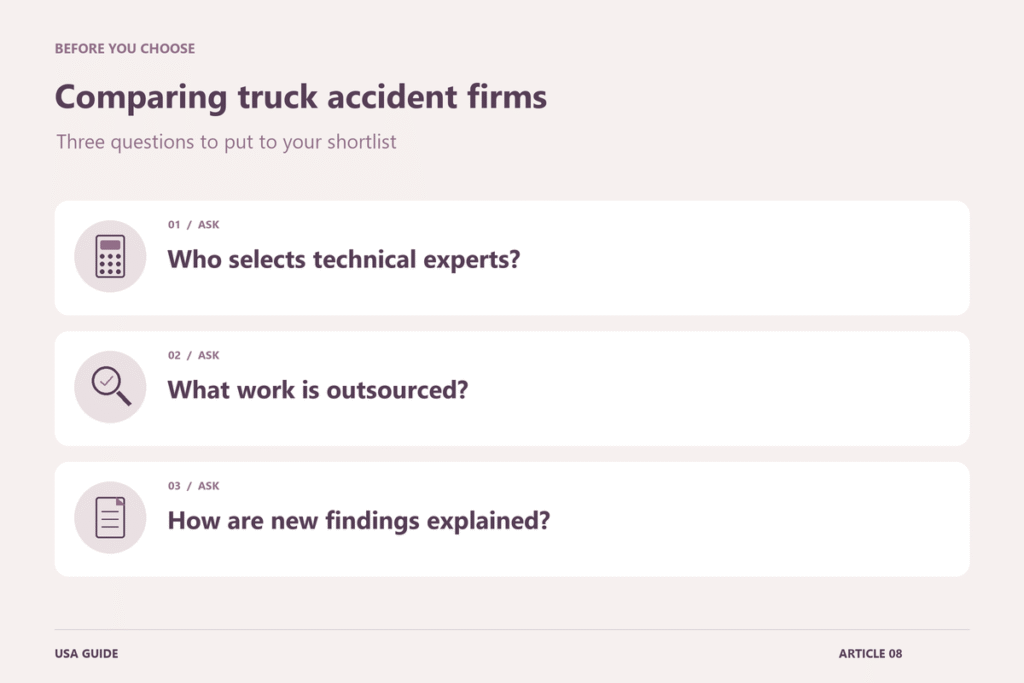
- Who selects technical experts?
- What work is outsourced?
- How are new findings explained?
A point that is easy to miss
Access to an expert is different from a commitment to instruct one. Ask what would trigger specialist work and how its scope and cost would be agreed.
Put the comparison into practice
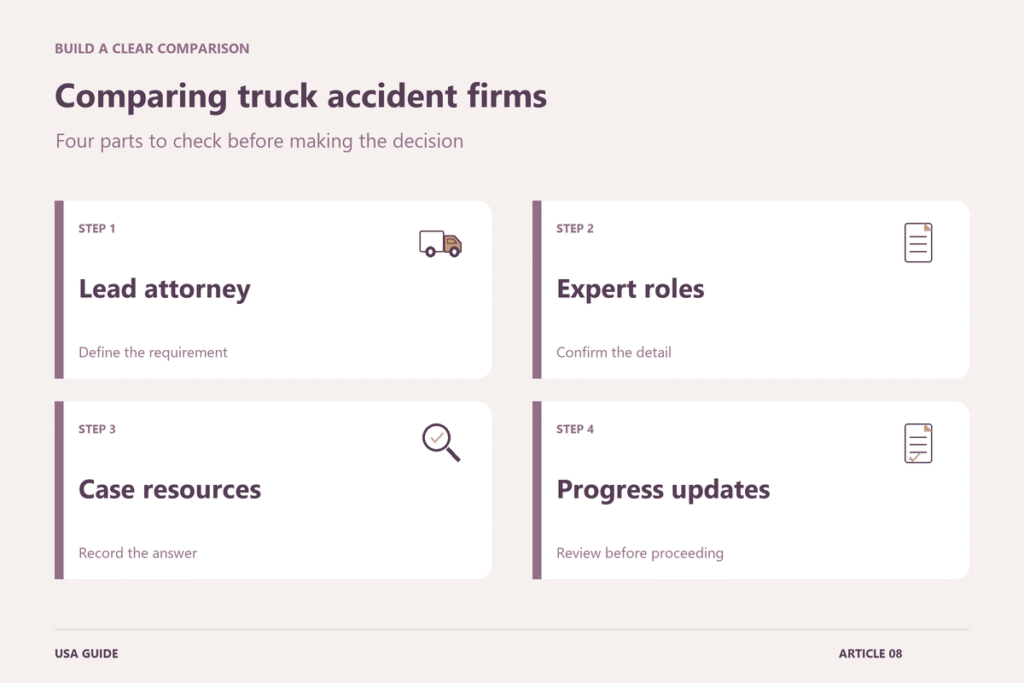
Request a short responsibility map showing the lead attorney, everyday contact, investigation coordinator and any outside professional the firm anticipates using. Ask which roles are already assigned and which would be decided later. A large list of possible experts is less informative than knowing who would identify a need, commission suitable work and explain the result.
Consider a practical communication test: ask how you would learn that an expert’s findings changed the firm’s view of the collision. Find out whether you would receive a scheduled discussion, a written summary or an opportunity to ask the attorney questions. Compare the promised process with your accessibility and scheduling needs. Include any separately handled vehicle or financial dispute in the map so that no important issue is assumed to be covered by an unrelated engagement.
Further reading
Related reading
- Commercial Vehicle Accident Attorney Fees: What to Compare Before Hiring (USA)
- How to Choose a Truck Accident Lawyer After a Serious Collision (USA)
- How to Choose a Solicitor for an HGV Accident Claim (UK)
- Commercial Vehicle Injury Claims: Comparing No Win No Fee Solicitors (UK)
Explore more in Truck and Commercial Vehicle Accidents.