Choosing a mesothelioma law firm starts with finding a team that can explain how it would investigate your exposure history. A national advertising campaign says little about who will handle your documents or answer your family. Compare the proposed investigation, the actual legal team and the written engagement together.
The decision this article helps you make
Shortlist firms using the same summary of your diagnosis and work history. Ask each team which facts it needs before assessing possible claims, rather than inviting an unsupported prediction of compensation.
Establish the exposure history before comparing firms
Prepare a timeline of jobs, work locations, products remembered and the people who may be able to help reconstruct events. Separate what you remember personally from what another person told you. Missing information is a question for the legal team, not a reason to invent a confident account. Ask how the firm would investigate historical employers and product information when records are incomplete.
Understand the proposed route and its boundaries
A conversation about an asbestos claim should distinguish the possible routes being investigated. Ask whether the proposed work concerns a lawsuit, a trust submission, a benefits application or some combination, and who would coordinate the decisions. Do not assume that eligibility for one route establishes eligibility for another. Request an explanation specific to your history rather than treating an online compensation figure as an estimate of your own recovery.
Look beyond the advertised fee
Ask the firm to show the stages covered by its engagement and identify work that would require separate approval. Questions about record collection, medical evidence, travel and outside specialists help expose differences between proposals. Ask how the amount you would receive would be calculated if more than one route produced a payment. Have the firm explain relevant deductions without relying on a universal percentage from an advertisement.
Assess the practical support available
Find out how interviews and document signing would be arranged if health, travel or family responsibilities make office visits difficult. Ask who would keep an authorised family contact informed and what permission would be required. The strongest comparison combines a credible investigation plan with a service arrangement you can actually use. Request individual advice promptly about deadlines; a general article cannot determine the filing timetable for your circumstances.
Test the provider before making the commitment
Turn the first conversation into a practical assessment. Describe your circumstances briefly, then ask the provider to explain its proposed approach, the information still missing and the next decision you would face. A useful explanation separates what can be confirmed now from what needs investigation. Record those answers immediately so that confident presentation does not become a substitute for substance when you compare candidates later.
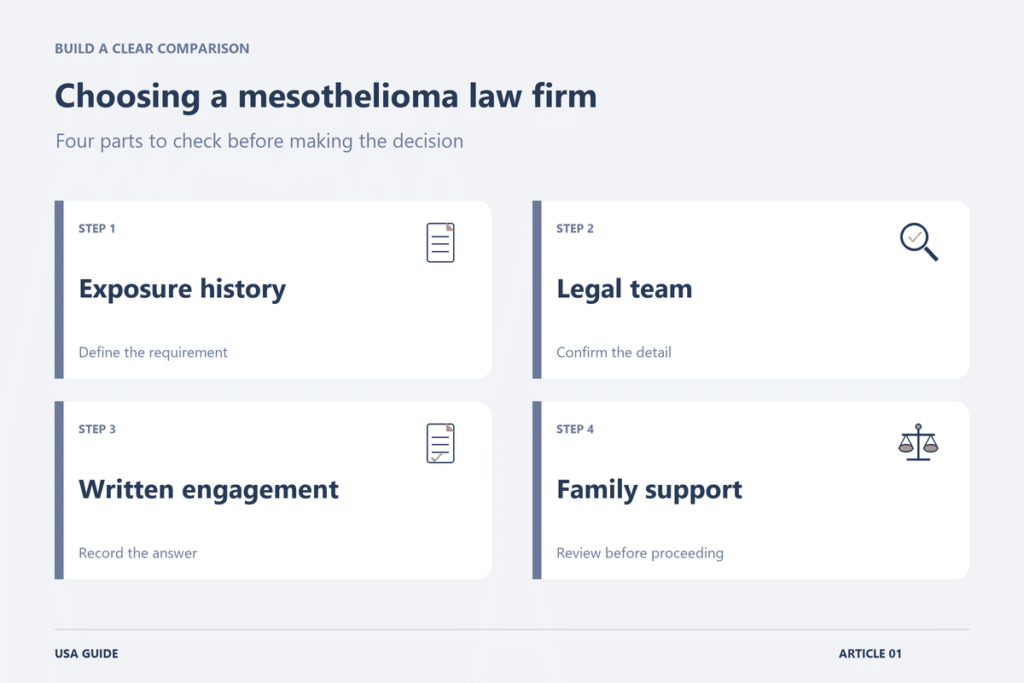
Ask who would actually do the work. The person who handles an initial enquiry may have a different role from the person responsible for delivery. Find out how you would reach the responsible professional, what happens during an absence and when progress updates would arrive. Request examples of the documents or reports you would receive, with identifying information removed. This tests the service you would experience rather than the quality of the sales pitch.
Then examine the conditions for leaving. Ask how records, work already completed, outstanding charges and any ongoing responsibilities would be handled if the relationship ended. The answer matters even when you expect to stay. A provider that can explain its boundaries, handover arrangements and unresolved issues gives you a more usable basis for selection than one that simply promises an effortless outcome.
Apply the comparison to your location
Use the state relevant to your situation when checking a provider’s qualifications and the terms of an offer. A national advertisement does not establish that the advertised service is available on the same terms where you live. Record the legal name of the organisation you would contract with, the office responsible for delivery and the date of its proposal. Ask which state-specific conditions affect your comparison. Keep personal identifiers out of initial comparison emails; use a verified secure channel when supporting documents are actually needed.
Questions to put to your shortlist
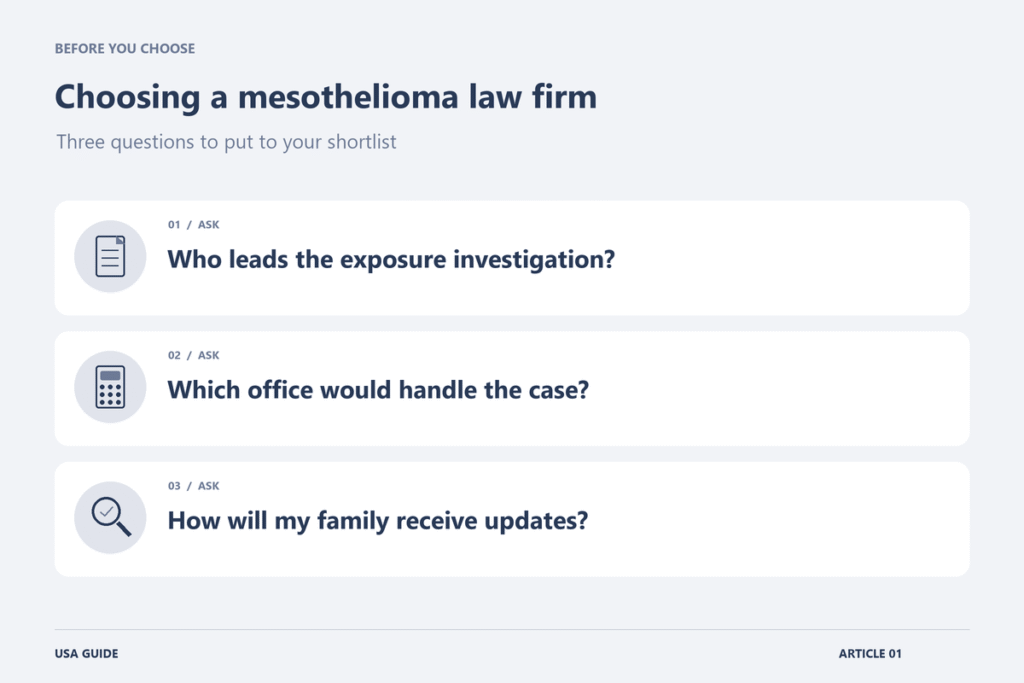
- Who leads the exposure investigation?
- Which office would handle the case?
- How will my family receive updates?
A point that is easy to miss
A firm may describe experience across many claims without having assessed yours. Ask it to connect that experience to the unanswered questions in your own history.
Put the comparison into practice
Ask the firm to describe the first few investigation tasks it would undertake after instruction. A useful response might identify interviews, a review of available records and questions about employers or products, while explaining that the sequence depends on what is found. You are assessing whether the team can organise the unknowns, not asking it to disclose another client’s confidential work.
Compare practical support with the demands on the person affected. Find out how documents can be reviewed securely, how an authorised relative can help and who explains requests that are difficult to fulfil. Write down which services are confirmed and which are simply available in principle. This makes an experienced national team and a smaller specialist practice easier to assess on the service each actually proposes.
Further reading
Related reading
- Mesothelioma Attorney Fees: Comparing Contingency Agreements (USA)
- Asbestos Trust Claims vs Lawsuits: Which Legal Route Should You Discuss With an Attorney? (USA)
- How to Compare Asbestos Compensation Solicitors (UK)
- No Win No Fee Mesothelioma Claims: Solicitor Costs and Questions to Ask (UK)
Explore more in Mesothelioma and Asbestos Claims.