Before hiring a lawyer for an insurance settlement dispute, identify the decision or offer you want assessed. Ask what documents the attorney would review and which work the proposed engagement covers. Representation for a specific dispute should not be assumed to include every related matter.
The decision this article helps you make
Compare the review, negotiation and possible further steps described by each attorney. Ask which developments would require a new agreement, additional spending or advice from a different specialist.
Make the charging arrangement understandable
Ask a legal provider to explain the difference between payment for professional work and amounts paid to other organisations. Then ask how the proposed agreement handles each. Advertising often compresses the arrangement into a short phrase; your decision needs the underlying terms. Have the provider identify which documents govern the relationship and resolve any inconsistency between the sales explanation and the written engagement.
Test more than one possible outcome
Ask for an explanation of what would happen if the matter resolves early, requires more work, ends unsuccessfully or is stopped by you. Use hypothetical examples with labelled assumptions. The aim is to understand the charging mechanism rather than obtain a prediction of a legal result. Ask whether a change in the work or strategy would require your approval and how a revised cost estimate would be communicated.
Check the scope alongside the price
Confirm which tasks the provider will undertake, who will perform them and which related disputes need separate representation. A price comparison is misleading if one engagement includes work another excludes. Ask who decides whether outside expertise is necessary, who approves the expenditure and what documentation you would receive. Keep funding questions connected to the actual services being proposed.
Preserve a clear record of the decision
Keep the engagement letter, funding documents, cost explanations and later revisions together. If the agreement remains unclear, request a written explanation before signing rather than relying on what you remember from a conversation. Ask where to raise a billing question and how a concern about service would be handled. Independent legal advice may be useful where the financial or procedural implications are difficult to understand; a general comparison cannot interpret an individual contract for you.
Examine what the package actually includes
Translate every broad description into an observable deliverable. Words such as comprehensive, premium and fully managed are not a substitute for an explanation of what the organisation will do. Ask for the tasks, the responsible people, the expected output and any conditions that limit delivery. The objective is to make the offer specific enough that you can recognise both completion and an omission.
Look carefully at the boundary between the main provider and third parties. A package may depend on another professional, a separate supplier or a product with its own terms. Ask who selects that third party, who receives the invoice and who responds if something goes wrong. Identify which commitments belong in your main agreement and which require separate confirmation. Do not assume that a referral automatically includes responsibility for the referred service.
Then check how changes are handled. Ask whether additional work needs your approval, how its price would be disclosed and what happens if you decline. A package can still be useful when it has exclusions, provided those exclusions are understandable and compatible with your needs. Compare the proposed scope against your own requirements rather than rewarding the longest feature list. Pay particular attention to the part of the service you would find hardest to replace yourself.
Apply the comparison to your location
Use the state relevant to your situation when checking a provider’s qualifications and the terms of an offer. A national advertisement does not establish that the advertised service is available on the same terms where you live. Record the legal name of the organisation you would contract with, the office responsible for delivery and the date of its proposal. Ask which state-specific conditions affect your comparison. Keep personal identifiers out of initial comparison emails; use a verified secure channel when supporting documents are actually needed.
Questions to put to your shortlist
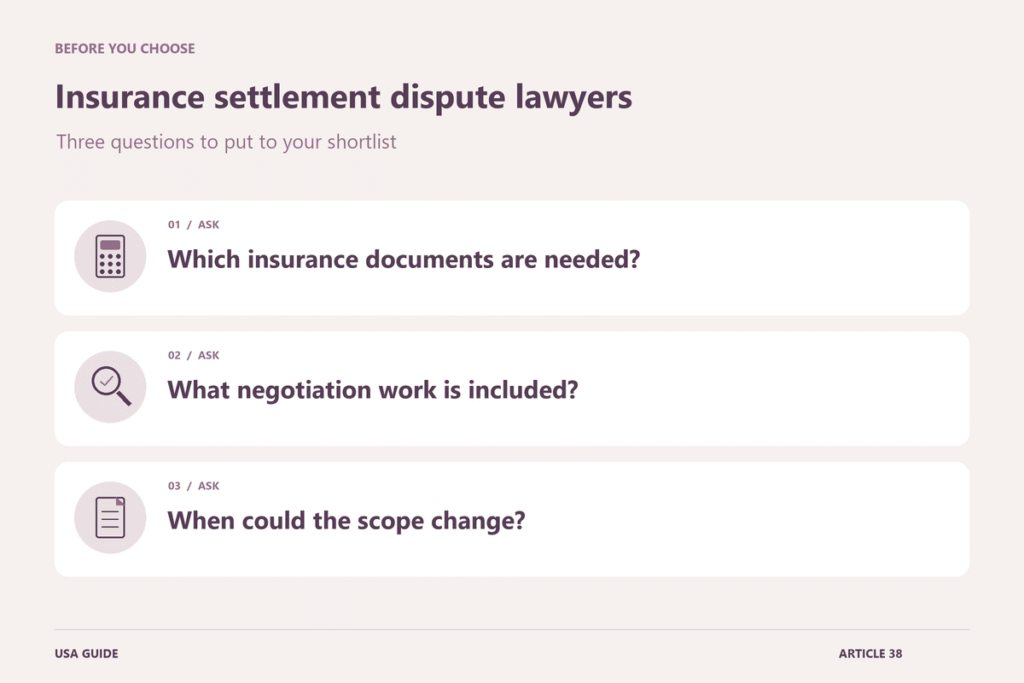
- Which insurance documents are needed?
- What negotiation work is included?
- When could the scope change?
A point that is easy to miss
An initial assessment can identify unanswered coverage or valuation questions without resolving them. Ask the lawyer what further work would be needed before relying on a conclusion.
Put the comparison into practice
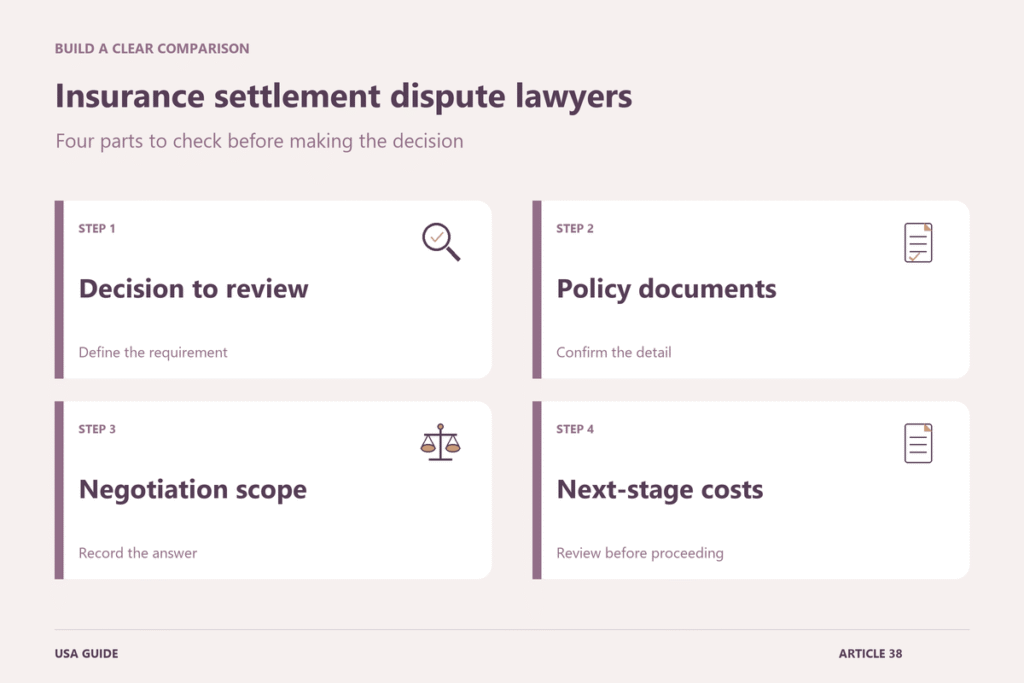
Start with the document or offer you want reviewed and the decision you need advice about. Ask the attorney which policy wording, correspondence and supporting information it needs to assess that question. An engagement to review an offer may be different from one to negotiate, investigate further or pursue proceedings, so ask where each stage begins and ends.
Compare how the lawyer would communicate advice and obtain authorisation for the next step. Identify any specialist input, separate dispute or outside expense that the proposal does not include. Ask how a change in scope would be disclosed and priced. The service should give you a clearer understanding of the decision before you, without treating a preliminary concern or an insurer’s initial position as a settled legal conclusion.
Further reading
Related reading
- Attorney Fees vs Case Expenses: Comparing the Total Cost of a Claim (USA)
- Personal Injury Contingency Agreements: Questions to Ask Before Signing (USA)
- Solicitor Success Fees: What to Check in a No Win No Fee Agreement (UK)
- Legal Expenses Insurance vs No Win No Fee Funding: What to Compare (UK)
Explore more in Lawyer Fees and Claim Process.