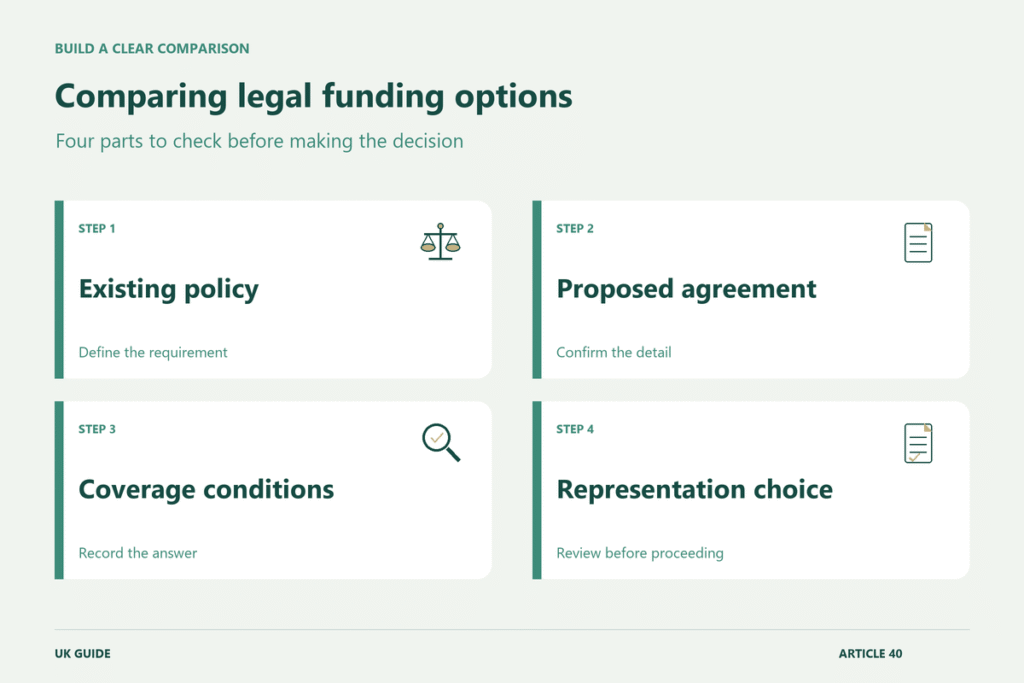
Comparing legal expenses insurance with no win no fee funding requires a review of the actual policy and proposed agreement. Ask a solicitor which options may apply to your circumstances and what conditions affect each. Neither route should be selected from a generic advertising description alone.
The decision this article helps you make
Compare eligibility, the work covered, possible deductions and any restrictions on representation. Ask who will review the policy and explain how the funding choice affects the service offered.
Make the charging arrangement understandable
Ask a legal provider to explain the difference between payment for professional work and amounts paid to other organisations. Then ask how the proposed agreement handles each. Advertising often compresses the arrangement into a short phrase; your decision needs the underlying terms. Have the provider identify which documents govern the relationship and resolve any inconsistency between the sales explanation and the written engagement.
Test more than one possible outcome
Ask for an explanation of what would happen if the matter resolves early, requires more work, ends unsuccessfully or is stopped by you. Use hypothetical examples with labelled assumptions. The aim is to understand the charging mechanism rather than obtain a prediction of a legal result. Ask whether a change in the work or strategy would require your approval and how a revised cost estimate would be communicated.
Check the scope alongside the price
Confirm which tasks the provider will undertake, who will perform them and which related disputes need separate representation. A price comparison is misleading if one engagement includes work another excludes. Ask who decides whether outside expertise is necessary, who approves the expenditure and what documentation you would receive. Keep funding questions connected to the actual services being proposed.
Preserve a clear record of the decision
Keep the engagement letter, funding documents, cost explanations and later revisions together. If the agreement remains unclear, request a written explanation before signing rather than relying on what you remember from a conversation. Ask where to raise a billing question and how a concern about service would be handled. Independent legal advice may be useful where the financial or procedural implications are difficult to understand; a general comparison cannot interpret an individual contract for you.
Compare the alternatives on the same basis
Choose the decision criteria before looking at promotional claims. Write down the outcome you need, the constraints you cannot change and the circumstances that would make an option unsuitable. Send the same basic requirements to each organisation. Otherwise, you may spend time comparing answers to different questions. A short comparison with clear assumptions is more useful than a long list of features that do not affect your decision.
Separate confirmed information from impressions. Written scope, disclosed charges and an identified delivery team belong in the first group. A persuasive conversation or an attractive website belongs in the second. Both can influence your experience, but they should not carry the same weight. Where an answer is missing, leave a visible gap rather than filling it with an optimistic assumption. Ask a follow-up question that could resolve the uncertainty.
Finally, test your preferred option against a plausible difficulty: a delay, a change in scope, an unavailable contact or an unexpected additional cost. Ask how the agreement would handle that situation. This can reveal important differences that a simple price ranking hides. Choose the option whose commitments and limitations you understand, and record why it fits your needs. If the essential information is still missing, improve the comparison before treating the shortlist as a final decision.
Apply the comparison to your location
UK-wide marketing can conceal differences between the services available in England, Wales, Scotland and Northern Ireland. Identify the nation relevant to your circumstances and ask the provider to explain any local limitations. Where regulation applies, check the appropriate register and the firm’s contact details independently. Registration is a starting check, not a promise of a particular outcome. Ask whether the quoted amount includes VAT where applicable, which organisation would take your payment and which complaints process applies to that specific service.
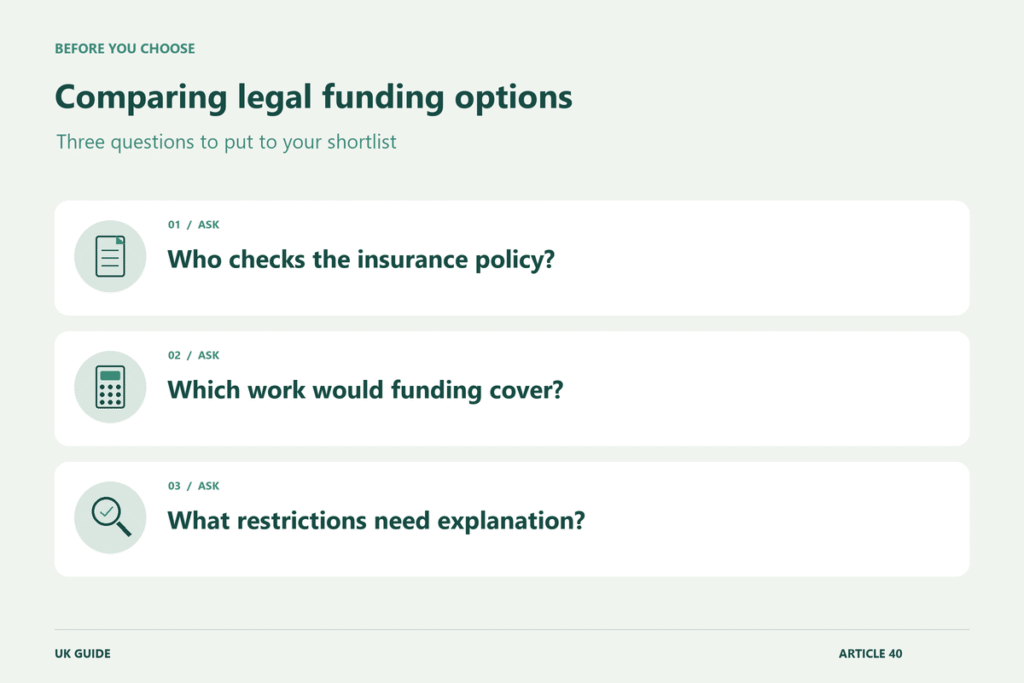
Questions to put to your shortlist
- Who checks the insurance policy?
- Which work would funding cover?
- What restrictions need explanation?
A point that is easy to miss
Existing insurance is relevant only if its terms support the matter in question. Ask for an assessment of the documents rather than assuming that the presence of a policy resolves the funding choice.
Put the comparison into practice
Place the existing insurance documents beside the proposed funding agreement and ask the solicitor to identify the questions each raises. Record whether coverage has been assessed, which work it might address and what conditions need clarification. Do not treat the mere existence of a policy as confirmation that it funds the matter or permits any chosen arrangement.
Compare the financial and service implications of the options actually available. Ask about possible deductions, choice of representative and the handling of outside expenses, without assuming one route is always preferable. Establish who will obtain necessary confirmations and who explains the final recommendation. If a funding decision depends on information not yet received, keep that uncertainty visible and ask how it affects the timing of the next step.
Further reading
Related reading
- Solicitor Success Fees: What to Check in a No Win No Fee Agreement (UK)
- Hiring a Lawyer for an Insurance Settlement Dispute: Fees and Services (USA)
- Attorney Fees vs Case Expenses: Comparing the Total Cost of a Claim (USA)
- Personal Injury Contingency Agreements: Questions to Ask Before Signing (USA)
Explore more in Lawyer Fees and Claim Process.