A private knee replacement quotation should reflect a clinician’s assessment and the plan proposed for you. Compare hospital and professional charges with rehabilitation and follow-up. A package description is incomplete if it leaves unclear who provides aftercare or what happens when recovery requires additional support.
The decision this article helps you make
Ask for an individual quote and identify separate consultation, imaging or follow-up costs. Review any finance agreement independently from the clinical decision and confirm which regulator covers the service location.
Begin with clinical suitability
A cost comparison should follow an assessment of what care may be appropriate for the individual patient. Ask a suitably qualified clinician to explain the proposed plan, alternatives and uncertainties. Do not select a treatment simply because a clinic packages it attractively. An educational buying guide can help you organise questions, but it cannot diagnose a condition or establish which procedure you should have.
Ask for an individual written plan
Request the proposed care, the professionals involved and the appointments or stages expected. Ask which parts of the plan may change after further assessment. Where a package is offered, have the clinic identify what is included and what would be billed separately. A starting price may describe a narrower service than the one recommended for your circumstances, so compare proposals only after clarifying their scope.
Compare follow-up and financial responsibilities
Ask about clinical follow-up, support between appointments and how an unexpected problem would be managed. Request clarification about the charges that could arise if further work is recommended. If using insurance, check coverage directly with the insurer as well as the provider; do not treat a clinic’s payment estimate as the insurer’s final decision. If financing is considered, review that borrowing separately from the clinical choice.
Assess the care setting and communication
Check the relevant professional and service registration and ask who is responsible for explaining the plan. In the UK, use the regulator appropriate to the nation and service; the Care Quality Commission’s remit is England. Consider travel, accessibility and the support available when you return home. A useful comparison combines a clinically appropriate plan with understandable costs and follow-up, without pretending that a published success rate or testimonial predicts an individual’s outcome.
Build a complete cost comparison
Start with a written breakdown rather than a headline amount. Separate the initial commitment, the main charge, payments to other organisations and any optional additions. Ask which figures are fixed, which are estimates and which depend on decisions that have not been made. Put the assumptions beside the numbers. Two apparently different prices may describe different amounts of work, while two identical prices may leave you with very different obligations.
Next, ask the provider to walk through a realistic change in circumstances. What happens if the work takes longer, an additional service becomes necessary or you decide to stop? Request an explanation of how a revised price would be approved and when you would be told. Do not treat an unknown amount as zero simply because it is missing from a quotation. Mark it as unresolved until you receive a useful answer.
Compare the total commitment over the period that matters to you. An introductory saving may be outweighed by later charges; an apparently expensive proposal may include work that another proposal bills separately. The aim is to understand those differences, not to make every offer look identical. Keep the original proposal, the provider’s clarifications and the final agreement together so that you can check what changed before authorising payment or signing.
Apply the comparison to your location
UK-wide marketing can conceal differences between the services available in England, Wales, Scotland and Northern Ireland. Identify the nation relevant to your circumstances and ask the provider to explain any local limitations. Where regulation applies, check the appropriate register and the firm’s contact details independently. Registration is a starting check, not a promise of a particular outcome. Ask whether the quoted amount includes VAT where applicable, which organisation would take your payment and which complaints process applies to that specific service.
Questions to put to your shortlist
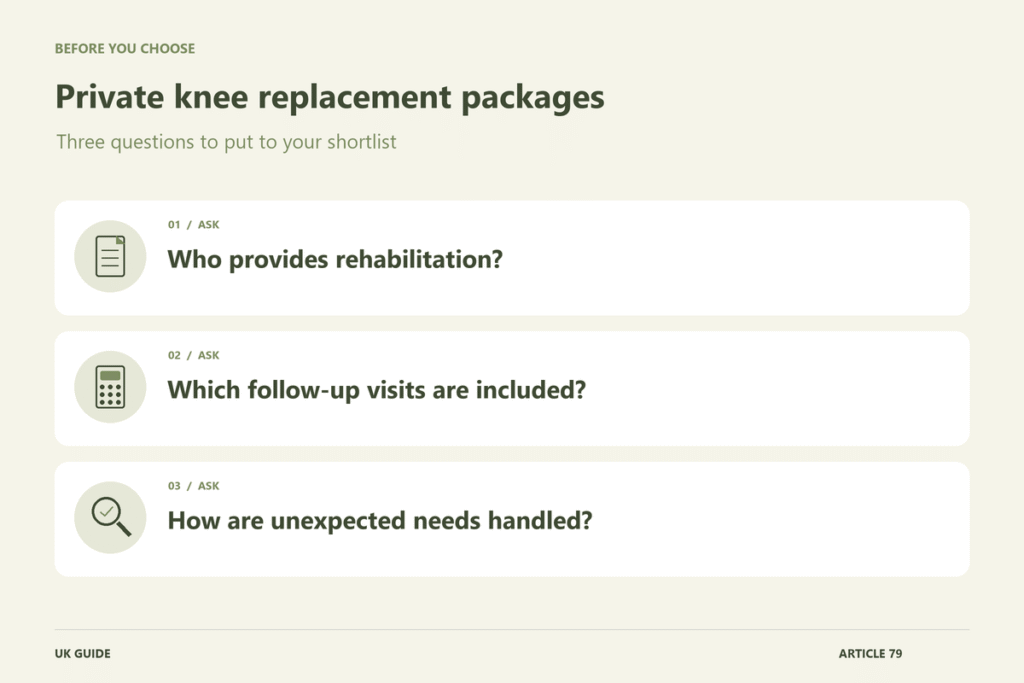
- Who provides rehabilitation?
- Which follow-up visits are included?
- How are unexpected needs handled?
A point that is easy to miss
A quoted package can be useful without covering every possible event. Ask the hospital to explain exclusions and the arrangements for additional care before relying on the total.
Put the comparison into practice
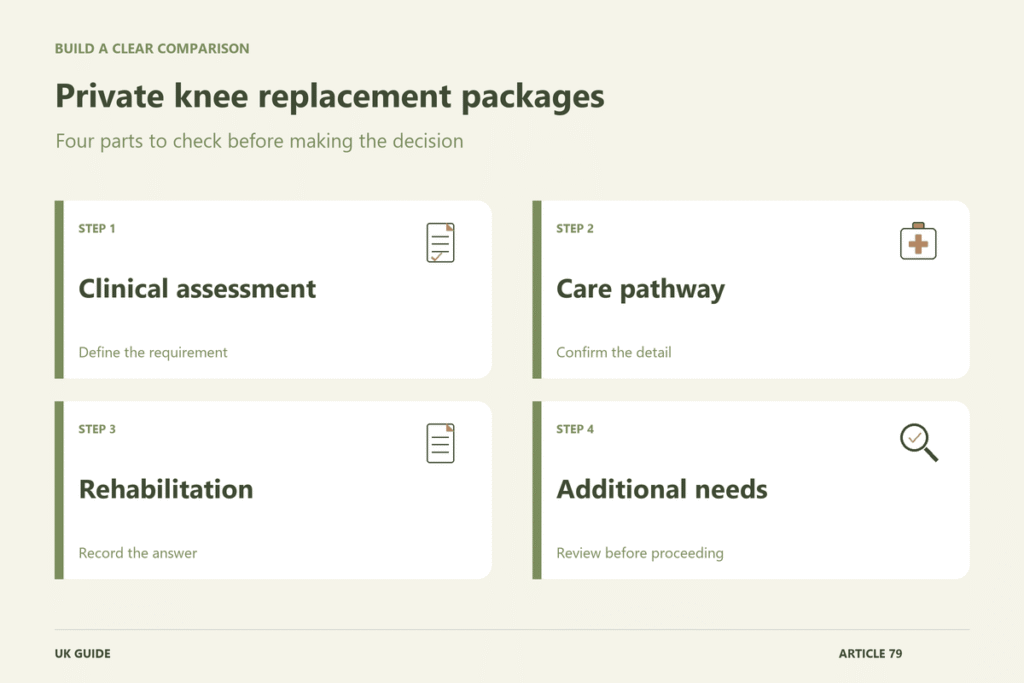
Ask the hospital to show the individual proposed care pathway and identify the charges for assessment, surgery, rehabilitation and follow-up. Establish which professionals supply each stage and whether any invoice comes from a separate organisation. Compare the scope before using a package total as a price ranking.
Ask how the provider handles additional clinical needs or a recovery that does not follow the initial expectation. You are not seeking a guarantee that complications cannot occur; you need an explanation of support and financial responsibilities. Confirm practical arrangements such as travel and follow-up location, and use the regulator appropriate to the nation where care is provided. Any finance proposal should be assessed separately so that the cost of borrowing is not confused with the quoted clinical package.
Further reading
Related reading
- Private Cataract Surgery Costs: Comparing Clinics, Lens Options and Fees (UK)
- IVF Clinic Costs: Comparing Treatment Packages, Testing and Medication Fees (USA)
- Private Drug Rehab Costs: Comparing Treatment Centres and Insurance Coverage (USA)
- Full-Mouth Dental Implant Costs: Comparing Clinic Quotes and Financing (USA)
Explore more in Healthcare and Treatment.