Industrial disease enquiries can involve historical employment and exposure questions that need careful investigation. Ask a prospective solicitor how the history would be reconstructed and which professional would lead the work. Compare the evidence plan and communication offered, not simply the specialist label.
The decision this article helps you make
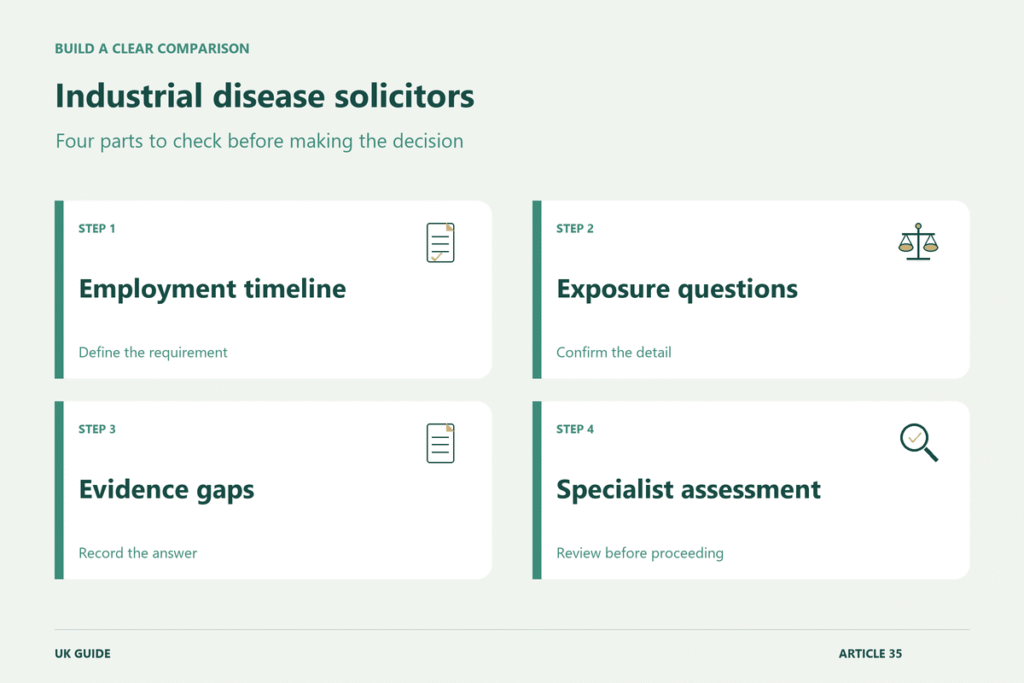
List employers, tasks and dates as accurately as you can, while identifying uncertainty. Ask the solicitor how it would investigate gaps and assess the legal routes relevant to your circumstances.
Organise the employment and incident history
Prepare a chronology covering the work performed, the incident or exposure being investigated and the documents already available. Retain relevant correspondence in its original form. Tell the legal team where your recollection is incomplete, particularly if the concern developed over a long period. A careful history helps the professional identify the questions to investigate without assuming that every workplace injury follows the same legal route.
Ask which routes require assessment
Workers’ compensation, employer-related claims and claims involving other organisations are not interchangeable labels. Ask the lawyer which routes may be relevant in the applicable jurisdiction and how their interaction would be reviewed. Do not assume that choosing a firm for one process covers every potential dispute. Get the scope of representation and any separate advice needed explained before accepting the engagement.
Compare evidence and practical support
Ask how the team would gather employment information, incident material and relevant clinical evidence. If the work history spans several employers or locations, ask who coordinates that investigation. Consider how the firm would accommodate treatment, shift work or difficulty attending appointments. A useful comparison establishes both the work proposed and the communication arrangements you would rely on while it is done.
Understand fees and decisions about employment
Ask how the proposed fee arrangement applies to the particular process being considered and which expenses might be separate. Keep questions about legal representation distinct from decisions about returning to work, treatment or employment changes. Those decisions may require individual clinical, employment or legal advice. Avoid relying on general online explanations for a deadline or eligibility conclusion that depends on your own work history and location.
Test the provider before making the commitment
Turn the first conversation into a practical assessment. Describe your circumstances briefly, then ask the provider to explain its proposed approach, the information still missing and the next decision you would face. A useful explanation separates what can be confirmed now from what needs investigation. Record those answers immediately so that confident presentation does not become a substitute for substance when you compare candidates later.
Ask who would actually do the work. The person who handles an initial enquiry may have a different role from the person responsible for delivery. Find out how you would reach the responsible professional, what happens during an absence and when progress updates would arrive. Request examples of the documents or reports you would receive, with identifying information removed. This tests the service you would experience rather than the quality of the sales pitch.
Then examine the conditions for leaving. Ask how records, work already completed, outstanding charges and any ongoing responsibilities would be handled if the relationship ended. The answer matters even when you expect to stay. A provider that can explain its boundaries, handover arrangements and unresolved issues gives you a more usable basis for selection than one that simply promises an effortless outcome.
Apply the comparison to your location
UK-wide marketing can conceal differences between the services available in England, Wales, Scotland and Northern Ireland. Identify the nation relevant to your circumstances and ask the provider to explain any local limitations. Where regulation applies, check the appropriate register and the firm’s contact details independently. Registration is a starting check, not a promise of a particular outcome. Ask whether the quoted amount includes VAT where applicable, which organisation would take your payment and which complaints process applies to that specific service.
Questions to put to your shortlist
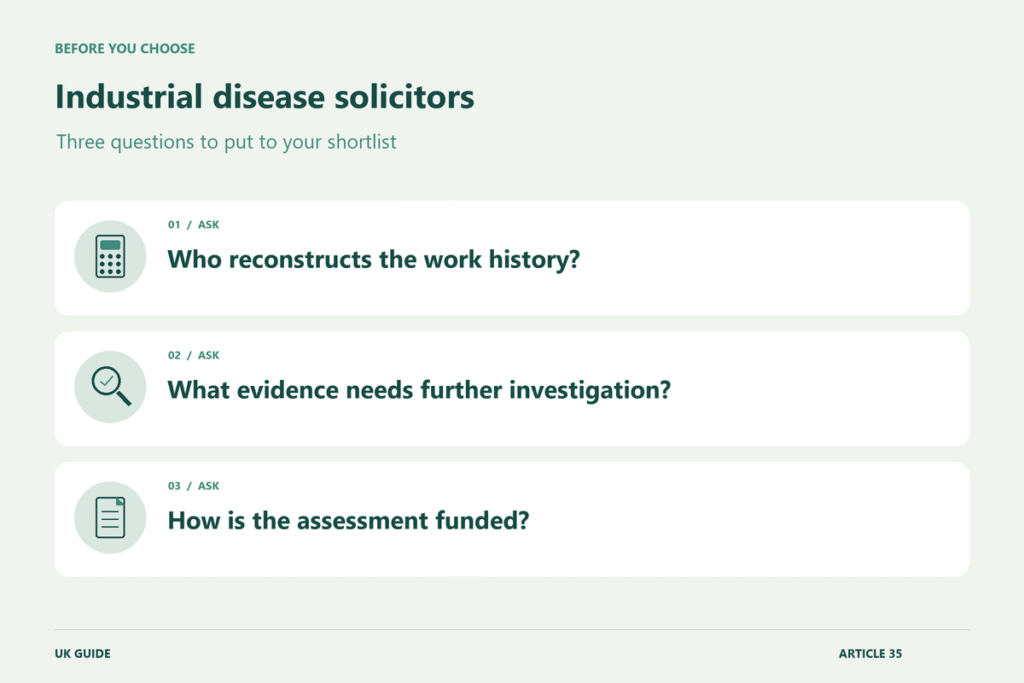
- Who reconstructs the work history?
- What evidence needs further investigation?
- How is the assessment funded?
A point that is easy to miss
Incomplete recollection does not justify filling gaps with guesses. Give the solicitor a reliable account of what you know and identify what still needs checking.
Put the comparison into practice
Use a historical work table with columns for employer, location, task, approximate period and supporting source. Label dates as approximate when necessary and distinguish memory from a document or another person’s account. Ask the solicitor which gaps it would investigate and which information may help an initial assessment. A reliable incomplete history is more useful than an apparently complete one filled with guesses.
Compare the firm’s plan for coordinating employment information and appropriate clinical evidence. Ask who would explain findings and how the work would be funded if the initial view changes. Check practical accessibility if health or distance makes appointments difficult. A specialist description should translate into an investigation and service plan relevant to your own history rather than a promise based on another person’s outcome.
Make the final decision from the written offer
Request a proposal that reflects the circumstances you actually discussed. Check the name of the contracting organisation, the work included, the charging basis and the person responsible for answering questions. Resolve any important difference between the conversation and the documents before proceeding. Keep a dated copy of the version you accept. If an essential assumption remains uncertain, ask what evidence would settle it and how that uncertainty could affect your next step.
Further reading
Related reading
- Accident at Work Claims: Comparing No Win No Fee Solicitors (UK)
- Workplace Injury Attorney vs Workers' Compensation Lawyer: Which Do You Need? (USA)
- Construction Accident Lawyers: How to Choose a Firm for a Serious Injury (USA)
- Workers' Compensation Lawyer Fees: What to Compare Before Hiring (USA)
Explore more in Workplace Injuries and Industrial Disease.