Compare jumbo mortgage proposals using the actual borrowing and property details rather than an advertised product label. Ask what documentation, reserves and underwriting conditions the lender would require. The strongest comparison joins pricing with a realistic understanding of the approval process.
The decision this article helps you make
Request equivalent proposals and ask which assumptions remain unverified. Compare lender charges and any relationship-based conditions without assuming that a preliminary rate is a final offer.
Establish the same comparison assumptions
Describe the property, borrowing amount, intended term and purpose consistently when requesting mortgage information. Ask what remains subject to valuation, underwriting or other checks. Rates and fees offered to one borrower do not establish what another borrower will receive. Keep the date of each proposal visible so that a change in market pricing is not confused with a difference between lenders.
Examine both upfront and ongoing costs
Compare the interest structure, scheduled payments, lender or product fees, broker charges and other amounts needed to complete the transaction. Ask which charges are added to the balance and which are paid separately. Request an explanation of what happens at the end of any initial pricing period. A small difference in the starting payment may conceal a larger difference in the commitment over the period you expect to keep the loan.
Test changes in your plans
Ask how the agreement handles early repayment, additional payments, moving or refinancing again. Where rates or payments can change, have the lender explain the mechanism and how a less favourable scenario would affect affordability. Do not use a simple payment saving as the only comparison if the new proposal extends the debt or changes the type of security involved.
Match the documents to the proposal
Request the appropriate formal information for the product and jurisdiction being considered. In a US mortgage comparison, use the relevant Loan Estimates to examine equivalent terms rather than treating a promotional rate as the full offer. In a UK comparison, ask the adviser to explain the applicable illustration and recommendation. Before proceeding, resolve differences in assumptions, costs and timing, and check that the eventual documents describe the loan you intended to compare.
Examine what the package actually includes
Translate every broad description into an observable deliverable. Words such as comprehensive, premium and fully managed are not a substitute for an explanation of what the organisation will do. Ask for the tasks, the responsible people, the expected output and any conditions that limit delivery. The objective is to make the offer specific enough that you can recognise both completion and an omission.

Look carefully at the boundary between the main provider and third parties. A package may depend on another professional, a separate supplier or a product with its own terms. Ask who selects that third party, who receives the invoice and who responds if something goes wrong. Identify which commitments belong in your main agreement and which require separate confirmation. Do not assume that a referral automatically includes responsibility for the referred service.
Then check how changes are handled. Ask whether additional work needs your approval, how its price would be disclosed and what happens if you decline. A package can still be useful when it has exclusions, provided those exclusions are understandable and compatible with your needs. Compare the proposed scope against your own requirements rather than rewarding the longest feature list. Pay particular attention to the part of the service you would find hardest to replace yourself.
Apply the comparison to your location
Use the state relevant to your situation when checking a provider’s qualifications and the terms of an offer. A national advertisement does not establish that the advertised service is available on the same terms where you live. Record the legal name of the organisation you would contract with, the office responsible for delivery and the date of its proposal. Ask which state-specific conditions affect your comparison. Keep personal identifiers out of initial comparison emails; use a verified secure channel when supporting documents are actually needed.
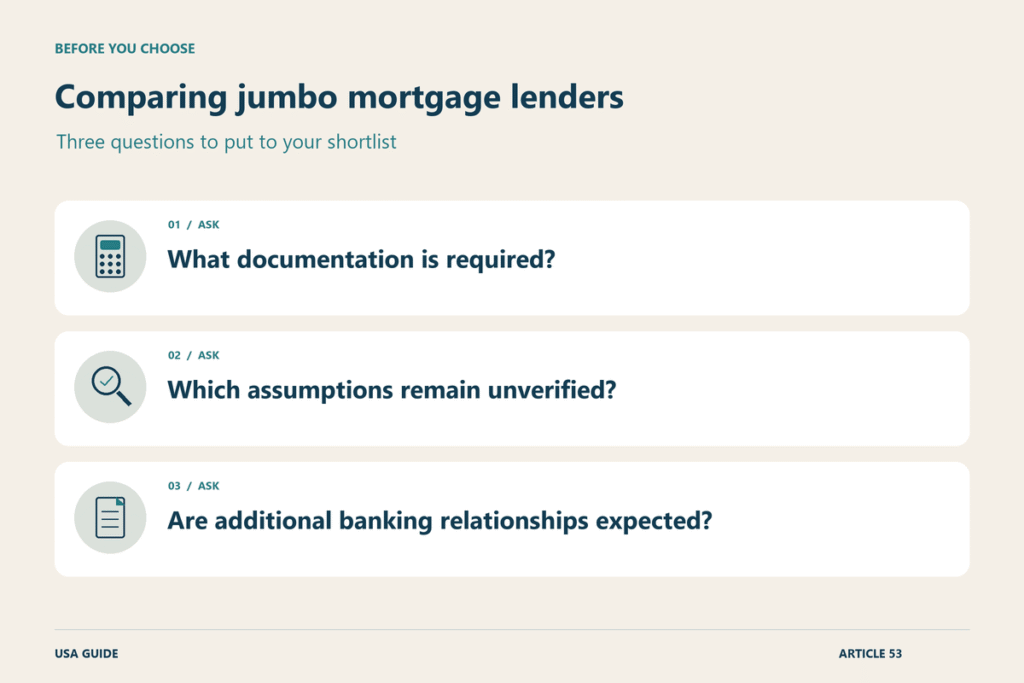
Questions to put to your shortlist
- What documentation is required?
- Which assumptions remain unverified?
- Are additional banking relationships expected?
A point that is easy to miss
A lender’s initial indication should not be treated as a commitment to fund. Ask what conditions remain and how their resolution could change the offer.
Put the comparison into practice
Request proposals using the same property, loan amount and intended structure, and ask which information remains subject to assessment. Compare documentation expectations, reserves and any additional relationship conditions alongside the stated pricing. A preliminary indication is difficult to evaluate if important conditions are left outside the comparison.
Ask how the lender would communicate changes after reviewing valuation or financial documents. Identify who is responsible for the application and how timing affects the proposed rate. If a banking relationship is part of the offer, examine its separate terms and costs rather than assuming it is free or convenient. Compare cash needed at completion and the repayment commitment, not just the rate displayed in an initial conversation about a large loan.
Make the final decision from the written offer
Request a proposal that reflects the circumstances you actually discussed. Check the name of the contracting organisation, the work included, the charging basis and the person responsible for answering questions. Resolve any important difference between the conversation and the documents before proceeding. Keep a dated copy of the version you accept. If an essential assumption remains uncertain, ask what evidence would settle it and how that uncertainty could affect your next step.
Further reading
Related reading
- HELOC vs Home Equity Loan: Comparing Lender Offers and Fees (USA)
- Mortgage Refinance Lenders: Comparing Rates and Closing Costs (USA)
- Remortgage Deals: Comparing Rates, Product Fees and Broker Costs (UK)
- Buy-to-Let Mortgage Brokers: Comparing Fees and Lender Access (UK)
Explore more in Mortgages.