An online nursing programme must be assessed against your educational background, location and professional goal. Ask the appropriate regulator and institution about eligibility rather than assuming online delivery removes location-based requirements. Compare practical arrangements alongside recognition and tuition.
The decision this article helps you make
Request a clear explanation of placements, supervised requirements and student responsibilities where applicable. Establish which costs and arrangements are confirmed before committing to a course intended to support a regulated career.
Define what the qualification must achieve
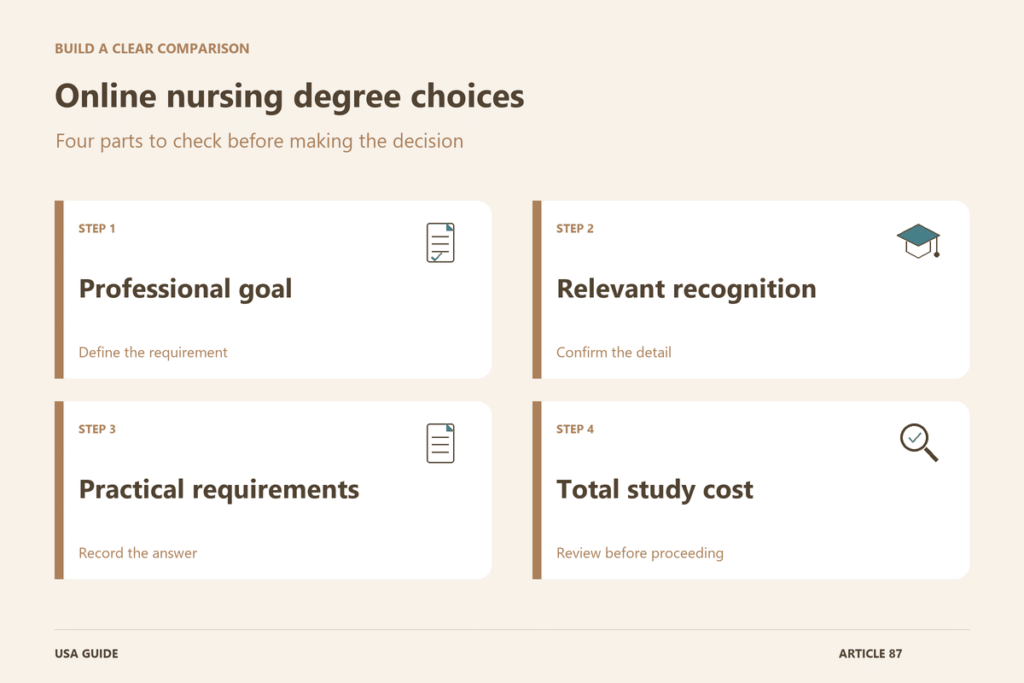
Identify whether you need academic study, professional eligibility, skills development or a qualification accepted by a particular employer. These goals can lead to different shortlists. Ask the relevant professional body or employer about recognition rather than relying only on a course provider’s description. An attractive programme title does not establish that it meets a licensing requirement or guarantees a particular career outcome.
Verify the institution and the programme
Check the awarding institution and any accreditation or professional recognition relevant to your goal. Distinguish recognition of the institution from recognition of a specific programme. Ask how location, online delivery and any practical placements affect eligibility. A provider’s marketing claim should be checked against an appropriate independent official source, especially where a regulated profession or cross-border study is involved.
Build the full study budget
Request tuition, mandatory fees, required materials, examinations and other necessary costs. Ask what happens if the course takes longer than expected or a module must be repeated. Include travel, placements and time away from paid work where relevant. Scholarships, employer contributions and finance offers should be checked against their actual conditions rather than treated as guaranteed reductions in the advertised price.
Compare delivery and completion support
Ask for a realistic timetable, the expected study load and the support available when work or family responsibilities disrupt progress. Request a demonstration of the learning environment and a clear explanation of assessment. Check deferral, withdrawal and refund arrangements before paying. A useful course comparison combines recognition, affordability and the ability to complete the work; it should not depend on a salary claim that may reflect a different group of graduates or circumstances from your own.
Examine what the package actually includes
Translate every broad description into an observable deliverable. Words such as comprehensive, premium and fully managed are not a substitute for an explanation of what the organisation will do. Ask for the tasks, the responsible people, the expected output and any conditions that limit delivery. The objective is to make the offer specific enough that you can recognise both completion and an omission.
Look carefully at the boundary between the main provider and third parties. A package may depend on another professional, a separate supplier or a product with its own terms. Ask who selects that third party, who receives the invoice and who responds if something goes wrong. Identify which commitments belong in your main agreement and which require separate confirmation. Do not assume that a referral automatically includes responsibility for the referred service.
Then check how changes are handled. Ask whether additional work needs your approval, how its price would be disclosed and what happens if you decline. A package can still be useful when it has exclusions, provided those exclusions are understandable and compatible with your needs. Compare the proposed scope against your own requirements rather than rewarding the longest feature list. Pay particular attention to the part of the service you would find hardest to replace yourself.
Apply the comparison to your location
Use the state relevant to your situation when checking a provider’s qualifications and the terms of an offer. A national advertisement does not establish that the advertised service is available on the same terms where you live. Record the legal name of the organisation you would contract with, the office responsible for delivery and the date of its proposal. Ask which state-specific conditions affect your comparison. Keep personal identifiers out of initial comparison emails; use a verified secure channel when supporting documents are actually needed.
Questions to put to your shortlist
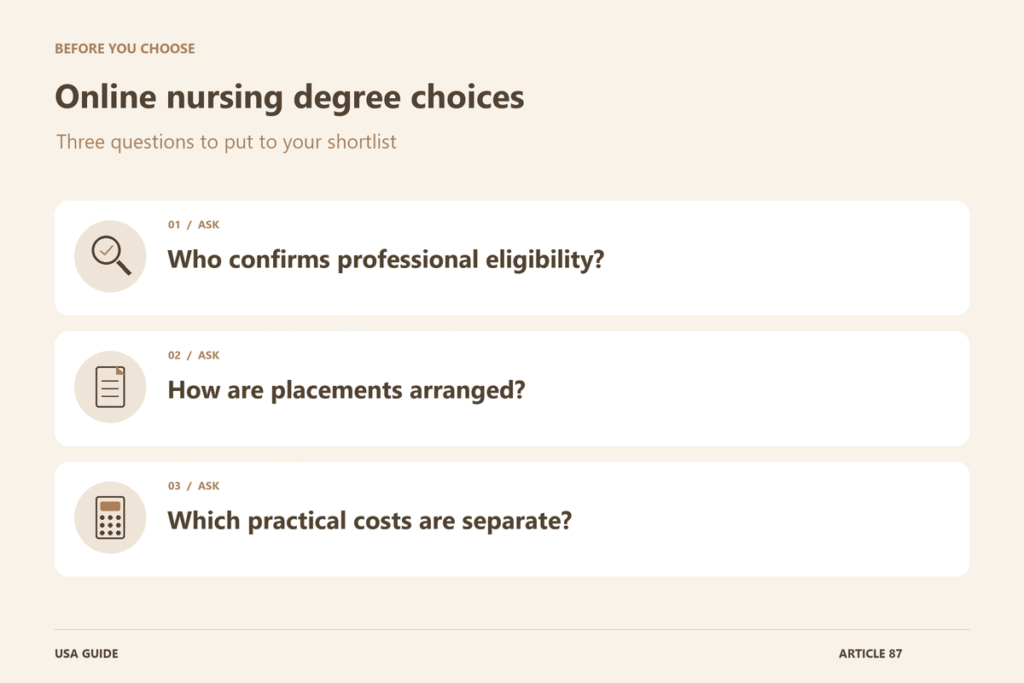
- Who confirms professional eligibility?
- How are placements arranged?
- Which practical costs are separate?
A point that is easy to miss
Admission to a programme does not itself establish eligibility for a professional licence. Check the requirements applicable to your intended location and role independently.
Put the comparison into practice
Start with the professional role and location you intend the programme to support, then ask the appropriate regulator about the relevant educational requirements. Have the institution explain its programme recognition and practical components against that goal. Do not assume that an online course can be completed or used professionally from every location simply because applications are accepted remotely.
Ask how placements or supervised work are arranged where required, who bears responsibility for securing them and which costs are separate. Compare the timetable, travel and access requirements with work and family commitments. Distinguish admission requirements, degree completion and professional licensing as questions requiring their own answers. Before paying, verify unresolved eligibility points independently rather than treating a provider’s general statement about career preparation as confirmation of your individual route into regulated practice.
Make the final decision from the written offer
Request a proposal that reflects the circumstances you actually discussed. Check the name of the contracting organisation, the work included, the charging basis and the person responsible for answering questions. Resolve any important difference between the conversation and the documents before proceeding. Keep a dated copy of the version you accept. If an essential assumption remains uncertain, ask what evidence would settle it and how that uncertainty could affect your next step.
Further reading
Related reading
- Accredited Online MBA Programs: Comparing Tuition, Fees and Specializations (USA)
- Online Master's in Cybersecurity: Comparing Tuition and Program Features (USA)
- Online MBA Courses: Comparing Accreditation, Tuition and Study Options (UK)
- Cybersecurity Certification Training Providers: Comparing Course and Exam Packages (UK)
Explore more in Education.