Accounting software should support the company’s transaction flow and the work shared with its accountant. Compare products through a sample sales, purchase and reconciliation workflow. Ask which plan supports the required users, reports and integrations before using the starting price as your decision criterion.
The decision this article helps you make
Have the accountant review access requirements and data exports. Examine how corrections and supporting documents are recorded, and ask which compliance-related tasks need a separate service or specialist review.
Turn the buying decision into a real workflow
Write down the job the software must support, the people involved and the information that moves between them. Include an ordinary case and an exception that currently causes difficulty. Ask vendors to demonstrate those scenarios rather than choosing from a feature list. A successful demonstration should show the work being completed, the permissions involved and the records you could inspect afterwards.
Price the configuration you would actually use
Identify the required plan, user types, usage limits and paid additions. Ask about implementation, training, migration and ongoing support as separate items. Compare annual and monthly commitments on the same basis, including what happens when the introductory period ends. A per-user headline may omit costs that matter more than the subscription difference between two products.
Test access and information handling
Use dummy data when evaluating a trial. Check how permissions are assigned, how changes can be reviewed and how the organisation would remove access when a person leaves. Ask the vendor to explain its responsibilities for security, availability and support without assuming that a familiar brand resolves every requirement. If sensitive information is involved, have appropriate legal or security staff review the proposed arrangement.
Plan migration and departure before signing
Ask which information can be imported and exported, what format is available and what assistance costs. Test an export rather than accepting a verbal promise that your data remains accessible. Identify the person responsible for the rollout, the training required and the criteria for accepting the system. A purchasing comparison should include the effort of adopting and eventually leaving the product, not simply the appearance of the dashboard during a sales call.
Examine what the package actually includes
Translate every broad description into an observable deliverable. Words such as comprehensive, premium and fully managed are not a substitute for an explanation of what the organisation will do. Ask for the tasks, the responsible people, the expected output and any conditions that limit delivery. The objective is to make the offer specific enough that you can recognise both completion and an omission.
Look carefully at the boundary between the main provider and third parties. A package may depend on another professional, a separate supplier or a product with its own terms. Ask who selects that third party, who receives the invoice and who responds if something goes wrong. Identify which commitments belong in your main agreement and which require separate confirmation. Do not assume that a referral automatically includes responsibility for the referred service.
Then check how changes are handled. Ask whether additional work needs your approval, how its price would be disclosed and what happens if you decline. A package can still be useful when it has exclusions, provided those exclusions are understandable and compatible with your needs. Compare the proposed scope against your own requirements rather than rewarding the longest feature list. Pay particular attention to the part of the service you would find hardest to replace yourself.
Apply the comparison to your location
UK-wide marketing can conceal differences between the services available in England, Wales, Scotland and Northern Ireland. Identify the nation relevant to your circumstances and ask the provider to explain any local limitations. Where regulation applies, check the appropriate register and the firm’s contact details independently. Registration is a starting check, not a promise of a particular outcome. Ask whether the quoted amount includes VAT where applicable, which organisation would take your payment and which complaints process applies to that specific service.
Questions to put to your shortlist
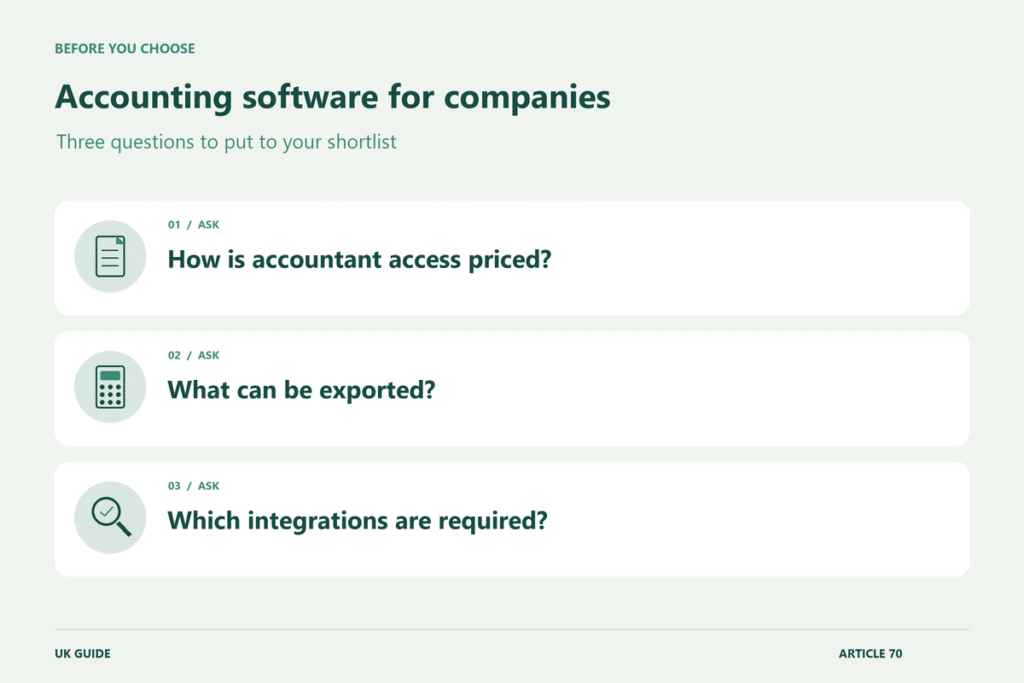
- How is accountant access priced?
- What can be exported?
- Which integrations are required?
A point that is easy to miss
A product described as accounting software does not automatically perform every filing or advisory task. Confirm the workflow and responsibilities with both the vendor and the professional supporting the company.
Put the comparison into practice
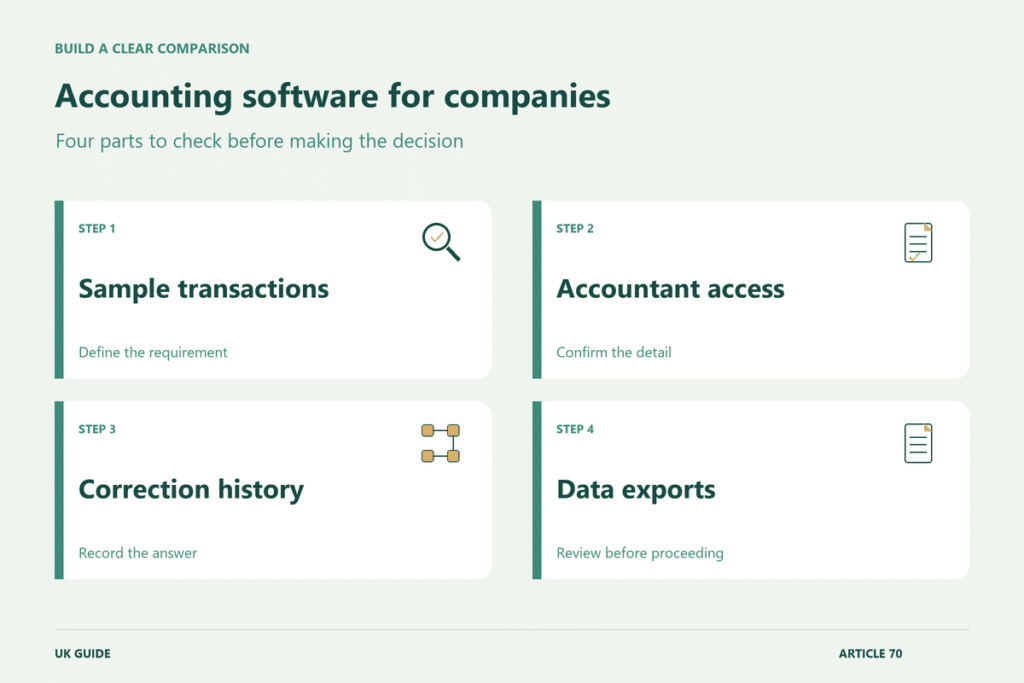
Choose a small set of fictional transactions and have the vendor show entry, document attachment, reconciliation and correction. Include the accountant’s review step so that the comparison reflects collaboration rather than a single-user demonstration. Record which plan and paid additions are required for the workflow being shown.
Test exports and ask what happens to records if the subscription ends or the company changes accountant. Compare the availability of supporting documents, access permissions and the history of corrections. Check which filings or related tasks are product functions and which depend on a separate professional service. An accounting system should help the company maintain a workable process, but a claim that software is suitable for limited companies does not explain the entire division of responsibility for records, reporting and advice.
Make the final decision from the written offer
Request a proposal that reflects the circumstances you actually discussed. Check the name of the contracting organisation, the work included, the charging basis and the person responsible for answering questions. Resolve any important difference between the conversation and the documents before proceeding. Keep a dated copy of the version you accept. If an essential assumption remains uncertain, ask what evidence would settle it and how that uncertainty could affect your next step.
Further reading
Related reading
- Payroll Software for Small Employers: Comparing Pricing and Reporting Features (UK)
- Business VoIP Providers: Comparing Per-User Pricing and Call Features (USA)
- CRM Software for Law Firms: Comparing Intake, Automation and Costs (USA)
- Payroll Software for Small Businesses: Comparing Pricing and Tax Features (USA)
Explore more in Business Software.