Families comparing birth injury law firms need a clear explanation of record review, professional roles and communication. Ask which questions the legal team would investigate and how outside clinical expertise might be used. Keep the legal assessment separate from the child’s current care decisions.
The decision this article helps you make
Compare who would coordinate records, communicate with authorised family members and explain findings. Ask how the team would handle new information or an assessment that does not support the original concern.
Separate a concern about care from a legal assessment
Prepare a chronology of the care received, the concern you want assessed and the effects you experienced. Identify the records already available and the questions you want a professional to investigate. An upsetting outcome does not, on its own, answer the legal questions. Ask the legal team to explain the assessment required without expecting a general article or a brief intake conversation to determine liability.
Ask how medical evidence would be reviewed
Find out who would organise records and decide whether independent clinical expertise is needed. Ask how the team would identify the relevant speciality and explain the questions put to an expert. You do not need to interpret technical records yourself to compare firms. You do need an understandable explanation of the investigative steps, their purpose and the points at which the assessment could change.
Compare funding with the proposed investigation
Medical evidence work can create questions about outside spending and the scope of representation. Ask which costs are anticipated, who approves them and how they would be treated if the matter does not proceed. Request an explanation of any separate funding arrangements rather than assuming that all work is covered by the same advertising slogan. Keep questions about legal costs distinct from decisions about your ongoing healthcare.
Check who will explain difficult findings
Ask how the team communicates when expert opinion does not support an initial concern or when further information is needed. A credible service should make room for uncertainty and unwelcome findings. Compare the named lawyer’s role, supervision and accessibility, particularly if the person affected needs communication support. Seek clinical advice for treatment decisions; selecting a legal representative is a separate task from determining which medical care is appropriate.
Examine what the package actually includes
Translate every broad description into an observable deliverable. Words such as comprehensive, premium and fully managed are not a substitute for an explanation of what the organisation will do. Ask for the tasks, the responsible people, the expected output and any conditions that limit delivery. The objective is to make the offer specific enough that you can recognise both completion and an omission.
Look carefully at the boundary between the main provider and third parties. A package may depend on another professional, a separate supplier or a product with its own terms. Ask who selects that third party, who receives the invoice and who responds if something goes wrong. Identify which commitments belong in your main agreement and which require separate confirmation. Do not assume that a referral automatically includes responsibility for the referred service.
Then check how changes are handled. Ask whether additional work needs your approval, how its price would be disclosed and what happens if you decline. A package can still be useful when it has exclusions, provided those exclusions are understandable and compatible with your needs. Compare the proposed scope against your own requirements rather than rewarding the longest feature list. Pay particular attention to the part of the service you would find hardest to replace yourself.
Apply the comparison to your location
Use the state relevant to your situation when checking a provider’s qualifications and the terms of an offer. A national advertisement does not establish that the advertised service is available on the same terms where you live. Record the legal name of the organisation you would contract with, the office responsible for delivery and the date of its proposal. Ask which state-specific conditions affect your comparison. Keep personal identifiers out of initial comparison emails; use a verified secure channel when supporting documents are actually needed.
Questions to put to your shortlist
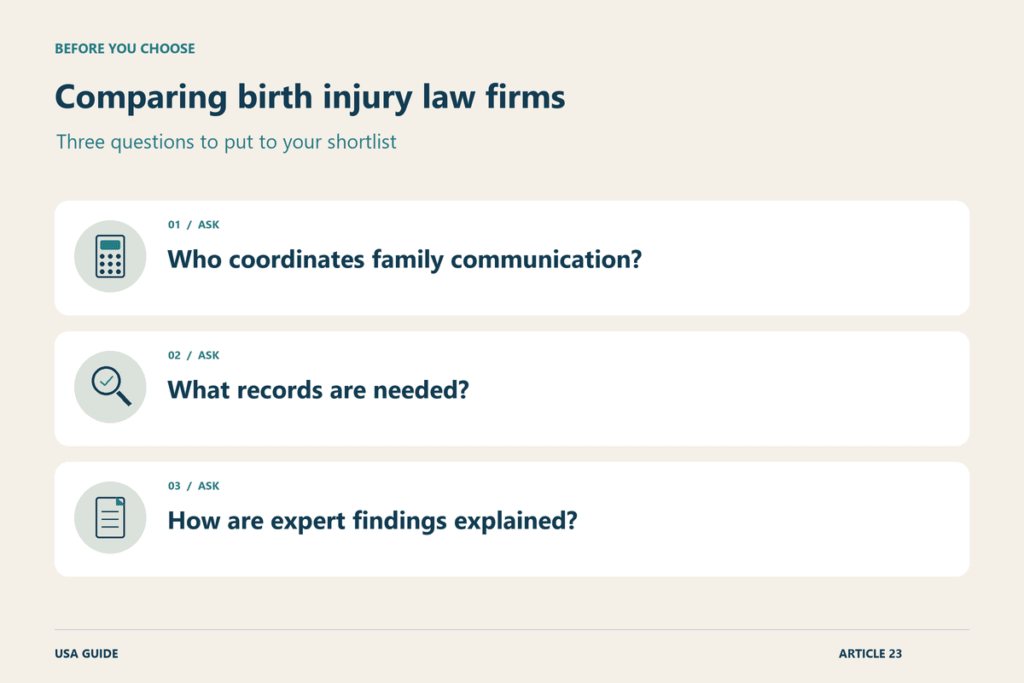
- Who coordinates family communication?
- What records are needed?
- How are expert findings explained?
A point that is easy to miss
A specialist website cannot determine what happened in an individual case. The useful comparison is the quality of the assessment process the firm proposes to undertake.
Put the comparison into practice
Ask the firm how it would organise a large or complex care record and identify the professional questions needing assessment. You are not expected to determine the clinical issue yourself. A useful proposal makes clear who coordinates the review, who chooses appropriate outside expertise and who explains its conclusions to the people authorised to instruct the firm.
Consider communication as a practical requirement. Ask how requests for records would be explained, how appointments can accommodate care responsibilities and how the firm responds when a question cannot yet be answered. Clarify the funding position if the initial assessment does not support further investigation. Comparing those steps helps distinguish an actual service plan from a compassionate advertising message without treating either the child’s future needs or the legal outcome as already established.
Further reading
Related reading
- Medical Malpractice Attorney Fees: Expert Witness Costs and Legal Expenses (USA)
- How to Choose a Medical Malpractice Lawyer (USA)
- Clinical Negligence Solicitors: Comparing Fees, Funding and Experience (UK)
- Private Hospital Negligence Claims: Choosing a Specialist Solicitor (UK)
Explore more in Medical Malpractice and Clinical Negligence.