Business cloud backup should be compared by the information protected and the restoration your organisation needs. Storage capacity alone is not a complete measure of the service. Ask how the provider handles failed jobs, access control and the practical steps involved in recovering data.
The decision this article helps you make
Use a controlled test with non-sensitive information to assess restore procedures. Compare retention, transfer charges and assistance with the time and effort your team would need during a disruption.
Define the service boundary first
List the systems, information and business activities the provider would support. Identify what your own team manages and what you expect the supplier to take over. Hosting, backup, security monitoring and incident recovery are related services, but they are not interchangeable. Ask the supplier to describe its responsibility for each rather than assuming that one managed package covers every operational need.
Compare capacity with recovery expectations
For an ordinary service, define acceptable performance and the work required when something fails. Ask what the provider measures, how an incident is reported and which support response is promised. A response target is different from a guarantee that the problem will be resolved within that period. Check the exact commitment and the conditions affecting it before using an availability figure as a purchasing shortcut.
Examine access and evidence
Ask how privileged access is granted, reviewed and removed. Establish who can make changes and what records of those changes you could obtain. If the provider handles sensitive information, involve appropriate security and legal reviewers in the comparison. Do not send production credentials or confidential records during an informal sales enquiry. Agree a suitable process before giving a supplier access to live systems.
Understand the contract and the exit
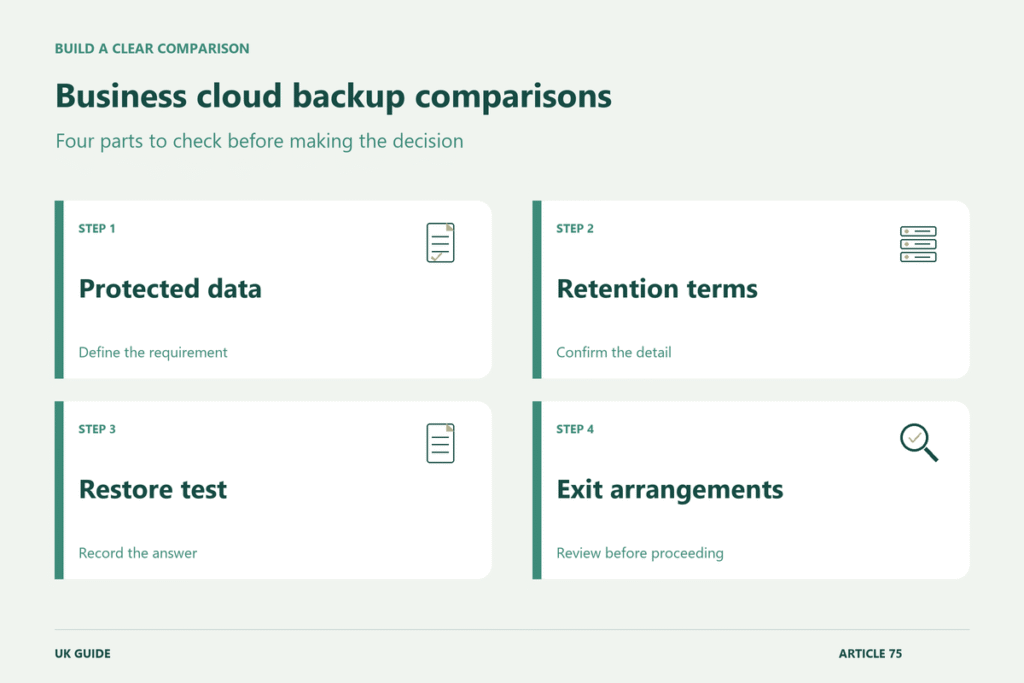
Request a cost breakdown covering setup, ongoing service, additional usage, incident work and any migration support. Ask what data and documentation would be returned at the end of the relationship and how that return would be tested. A backup or recovery claim becomes more useful when a controlled restoration demonstrates what is actually available. Compare practical responsibilities and tested procedures rather than relying only on brand recognition or a long list of security terms.
Compare the alternatives on the same basis
Choose the decision criteria before looking at promotional claims. Write down the outcome you need, the constraints you cannot change and the circumstances that would make an option unsuitable. Send the same basic requirements to each organisation. Otherwise, you may spend time comparing answers to different questions. A short comparison with clear assumptions is more useful than a long list of features that do not affect your decision.
Separate confirmed information from impressions. Written scope, disclosed charges and an identified delivery team belong in the first group. A persuasive conversation or an attractive website belongs in the second. Both can influence your experience, but they should not carry the same weight. Where an answer is missing, leave a visible gap rather than filling it with an optimistic assumption. Ask a follow-up question that could resolve the uncertainty.
Finally, test your preferred option against a plausible difficulty: a delay, a change in scope, an unavailable contact or an unexpected additional cost. Ask how the agreement would handle that situation. This can reveal important differences that a simple price ranking hides. Choose the option whose commitments and limitations you understand, and record why it fits your needs. If the essential information is still missing, improve the comparison before treating the shortlist as a final decision.
Apply the comparison to your location
UK-wide marketing can conceal differences between the services available in England, Wales, Scotland and Northern Ireland. Identify the nation relevant to your circumstances and ask the provider to explain any local limitations. Where regulation applies, check the appropriate register and the firm’s contact details independently. Registration is a starting check, not a promise of a particular outcome. Ask whether the quoted amount includes VAT where applicable, which organisation would take your payment and which complaints process applies to that specific service.
Questions to put to your shortlist
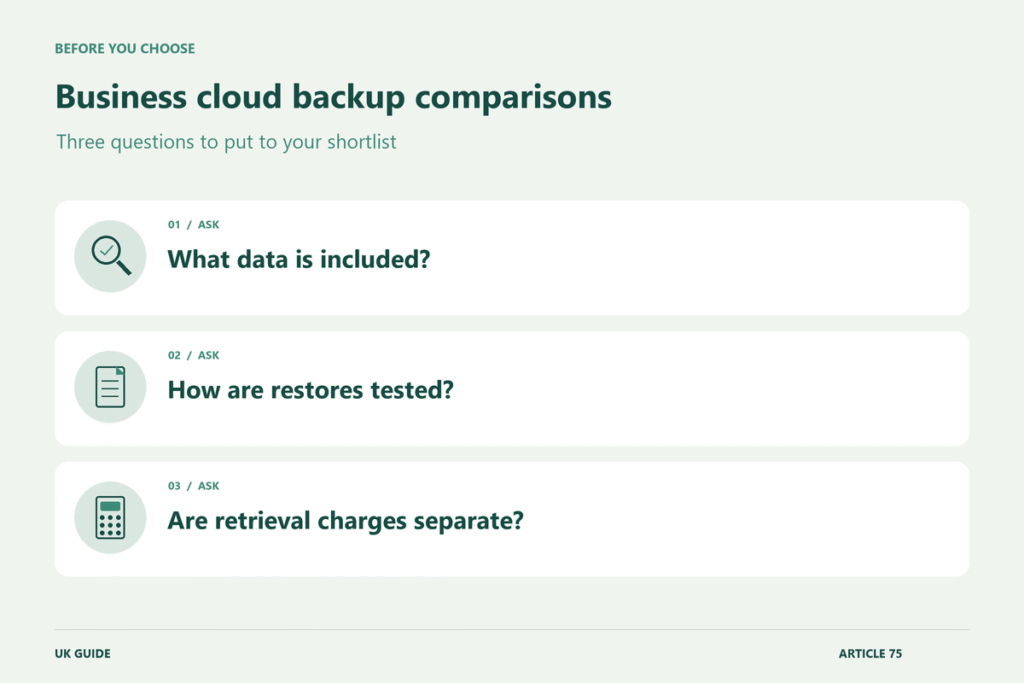
- What data is included?
- How are restores tested?
- Are retrieval charges separate?
A point that is easy to miss
Having a copy and being able to restore the right information are different questions. Ask the provider to demonstrate the latter before relying on a storage headline.
Put the comparison into practice
Choose a controlled restoration scenario using non-sensitive data and ask the provider to demonstrate the steps. Record which information is restored, how a version is selected, what assistance is needed and which charges apply. This turns a storage comparison into a practical assessment of whether the service can support recovery of the data your business needs.
Ask how failed backup jobs are detected and who is responsible for investigating them. Compare retention, access controls and deletion arrangements alongside storage limits. Include the process for recovering data after a supplier change or subscription closure. A large advertised capacity is not enough if essential sources are excluded or restoration is difficult. Review the actual protected systems and recovery responsibilities before relying on a general claim that the business is backed up.
Make the final decision from the written offer
Request a proposal that reflects the circumstances you actually discussed. Check the name of the contracting organisation, the work included, the charging basis and the person responsible for answering questions. Resolve any important difference between the conversation and the documents before proceeding. Keep a dated copy of the version you accept. If an essential assumption remains uncertain, ask what evidence would settle it and how that uncertainty could affect your next step.
Further reading
Related reading
- Managed Cybersecurity Providers for Small Businesses: Comparing Services and Costs (UK)
- Ransomware Recovery Services: Comparing Providers, Response Times and Pricing (USA)
- Dedicated Server Hosting Providers: Comparing Hardware, SLAs and Costs (USA)
- Managed WordPress Hosting for Businesses: Comparing Pricing and Support (USA)
Explore more in Hosting and Cybersecurity.