A managed cybersecurity service should define the systems covered, monitoring responsibilities and actions the provider can take. Compare those commitments with your business’s needs and internal capacity. A list of tools does not explain who investigates an alert or makes a decision during an incident.
The decision this article helps you make
Ask vendors to walk through a realistic alert from detection to escalation. Compare the named responsibilities, support hours and charges for work outside the ongoing agreement.
Define the service boundary first
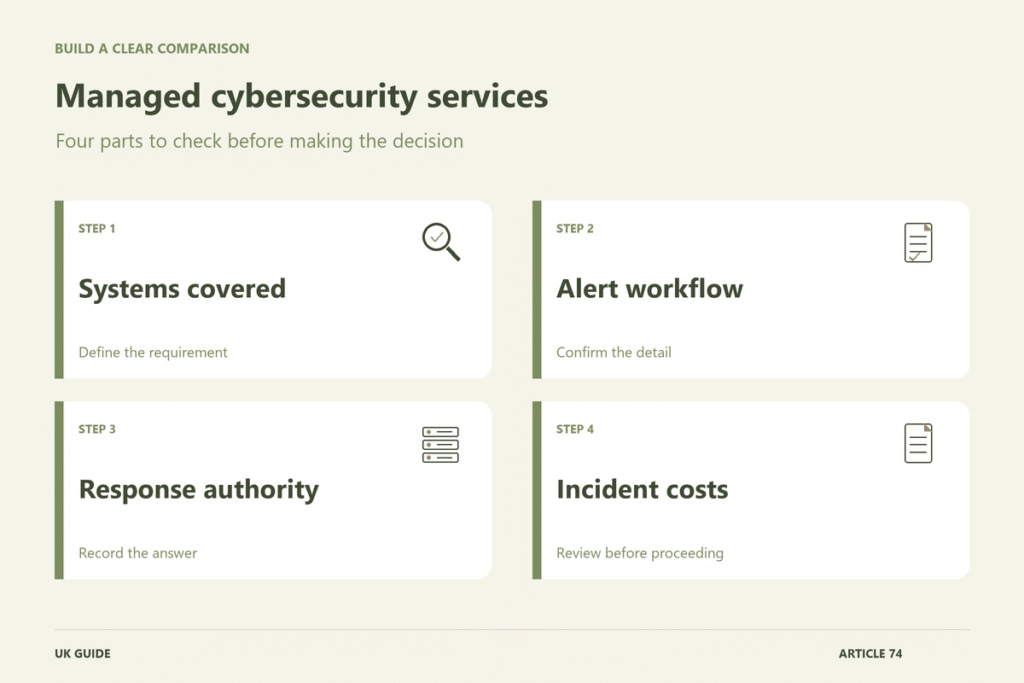
List the systems, information and business activities the provider would support. Identify what your own team manages and what you expect the supplier to take over. Hosting, backup, security monitoring and incident recovery are related services, but they are not interchangeable. Ask the supplier to describe its responsibility for each rather than assuming that one managed package covers every operational need.
Compare capacity with recovery expectations
For an ordinary service, define acceptable performance and the work required when something fails. Ask what the provider measures, how an incident is reported and which support response is promised. A response target is different from a guarantee that the problem will be resolved within that period. Check the exact commitment and the conditions affecting it before using an availability figure as a purchasing shortcut.
Examine access and evidence
Ask how privileged access is granted, reviewed and removed. Establish who can make changes and what records of those changes you could obtain. If the provider handles sensitive information, involve appropriate security and legal reviewers in the comparison. Do not send production credentials or confidential records during an informal sales enquiry. Agree a suitable process before giving a supplier access to live systems.
Understand the contract and the exit
Request a cost breakdown covering setup, ongoing service, additional usage, incident work and any migration support. Ask what data and documentation would be returned at the end of the relationship and how that return would be tested. A backup or recovery claim becomes more useful when a controlled restoration demonstrates what is actually available. Compare practical responsibilities and tested procedures rather than relying only on brand recognition or a long list of security terms.
Examine what the package actually includes
Translate every broad description into an observable deliverable. Words such as comprehensive, premium and fully managed are not a substitute for an explanation of what the organisation will do. Ask for the tasks, the responsible people, the expected output and any conditions that limit delivery. The objective is to make the offer specific enough that you can recognise both completion and an omission.
Look carefully at the boundary between the main provider and third parties. A package may depend on another professional, a separate supplier or a product with its own terms. Ask who selects that third party, who receives the invoice and who responds if something goes wrong. Identify which commitments belong in your main agreement and which require separate confirmation. Do not assume that a referral automatically includes responsibility for the referred service.
Then check how changes are handled. Ask whether additional work needs your approval, how its price would be disclosed and what happens if you decline. A package can still be useful when it has exclusions, provided those exclusions are understandable and compatible with your needs. Compare the proposed scope against your own requirements rather than rewarding the longest feature list. Pay particular attention to the part of the service you would find hardest to replace yourself.
Apply the comparison to your location
UK-wide marketing can conceal differences between the services available in England, Wales, Scotland and Northern Ireland. Identify the nation relevant to your circumstances and ask the provider to explain any local limitations. Where regulation applies, check the appropriate register and the firm’s contact details independently. Registration is a starting check, not a promise of a particular outcome. Ask whether the quoted amount includes VAT where applicable, which organisation would take your payment and which complaints process applies to that specific service.
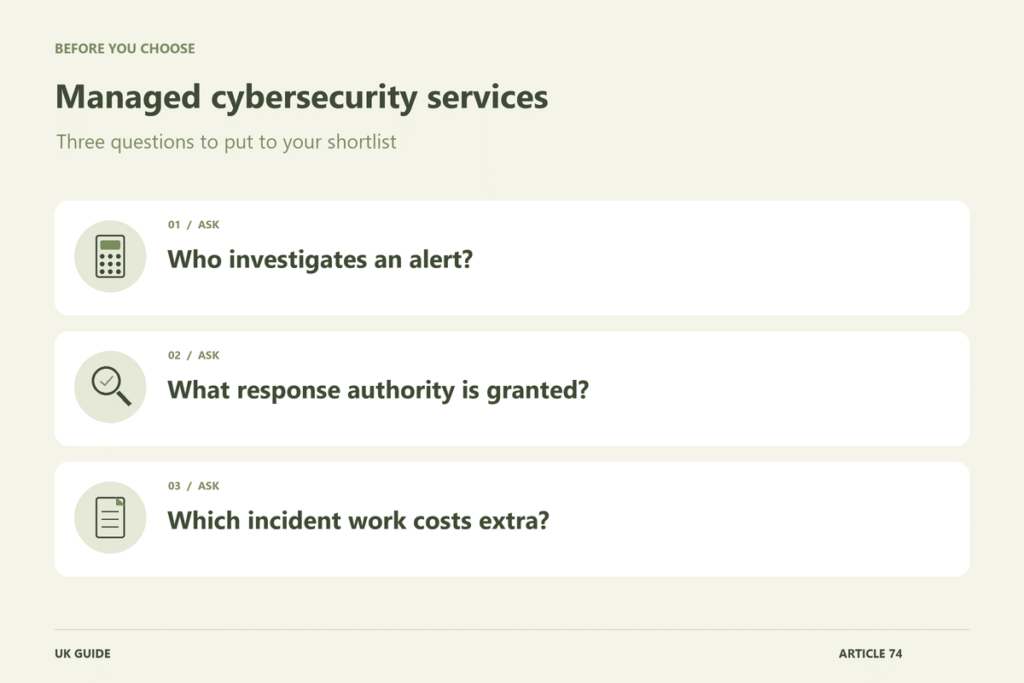
Questions to put to your shortlist
- Who investigates an alert?
- What response authority is granted?
- Which incident work costs extra?
A point that is easy to miss
Monitoring and incident remediation may be separate services. Ask the provider to explain where its responsibility ends and who takes over when a problem requires more work.
Put the comparison into practice
Use a sample alert to test the whole service: receipt, triage, investigation, escalation and authority to act. Ask which steps the supplier performs directly and which require your team or a separate incident provider. Record the support hours and commitments relevant to each step rather than treating one response-time headline as the entire arrangement.
Compare how the service handles onboarding, privileged access and the departure of staff or suppliers. Ask what evidence and reports the business would receive and how additional incident work is priced. A list of security tools does not by itself establish that someone is responsible for making and communicating a decision. The practical value lies in the responsibilities, coverage and working process that the agreement actually commits to for your organisation.
Make the final decision from the written offer
Request a proposal that reflects the circumstances you actually discussed. Check the name of the contracting organisation, the work included, the charging basis and the person responsible for answering questions. Resolve any important difference between the conversation and the documents before proceeding. Keep a dated copy of the version you accept. If an essential assumption remains uncertain, ask what evidence would settle it and how that uncertainty could affect your next step.
Further reading
Related reading
- Business Cloud Backup Services: Comparing Storage, Recovery and Pricing (UK)
- Ransomware Recovery Services: Comparing Providers, Response Times and Pricing (USA)
- Dedicated Server Hosting Providers: Comparing Hardware, SLAs and Costs (USA)
- Managed WordPress Hosting for Businesses: Comparing Pricing and Support (USA)
Explore more in Hosting and Cybersecurity.