No win no fee proposals for commercial vehicle injury claims should be compared as complete agreements. Ask about success-related deductions, investigation spending and the arrangements if the claim is unsuccessful. The same slogan can conceal different conditions and different service arrangements.
The decision this article helps you make
Use a comparison sheet covering the named solicitor, proposed investigation, funding basis and possible additional costs. Leave unanswered points visible instead of assuming they are covered.
Compare the investigation plan
Write a factual account of the collision while keeping uncertainties visible. Record the location, vehicles involved, available photographs and the organisations that have contacted you. Tell the legal team which documents already exist and which you do not have. Ask what evidence may need prompt professional attention; do not attempt to obtain private company records or enter an unsafe location yourself.
Identify who would do the specialist work
Ask a prospective firm how it would assess the vehicle operator, the circumstances of the journey and any other potentially relevant parties. A useful answer explains the investigation it would undertake, rather than assuming responsibility before examining evidence. If outside reconstruction or technical expertise might be needed, ask who would select the expert, approve the expense and explain the conclusions to you.
Separate the legal fee from investigation expenses
Two proposals with the same headline charging arrangement can still allocate investigation costs differently. Request an explanation of record retrieval, expert work and other spending that the team anticipates. Ask which expenses need your approval and how you would be kept informed as the case develops. Any illustration should identify assumed figures rather than presenting a generic settlement amount as likely.
Check communication and insurer coordination
Ask who would handle insurer correspondence and what information the firm needs from you before doing so. Preserve original communications and avoid treating an informal conversation as a complete settlement explanation. Find out how the team would coordinate injury evidence with the practical effects on work and daily life. Your comparison should favour an understandable case plan and clear responsibility for updates, not simply an impressive list of past results from unrelated collisions.
Compare the alternatives on the same basis
Choose the decision criteria before looking at promotional claims. Write down the outcome you need, the constraints you cannot change and the circumstances that would make an option unsuitable. Send the same basic requirements to each organisation. Otherwise, you may spend time comparing answers to different questions. A short comparison with clear assumptions is more useful than a long list of features that do not affect your decision.
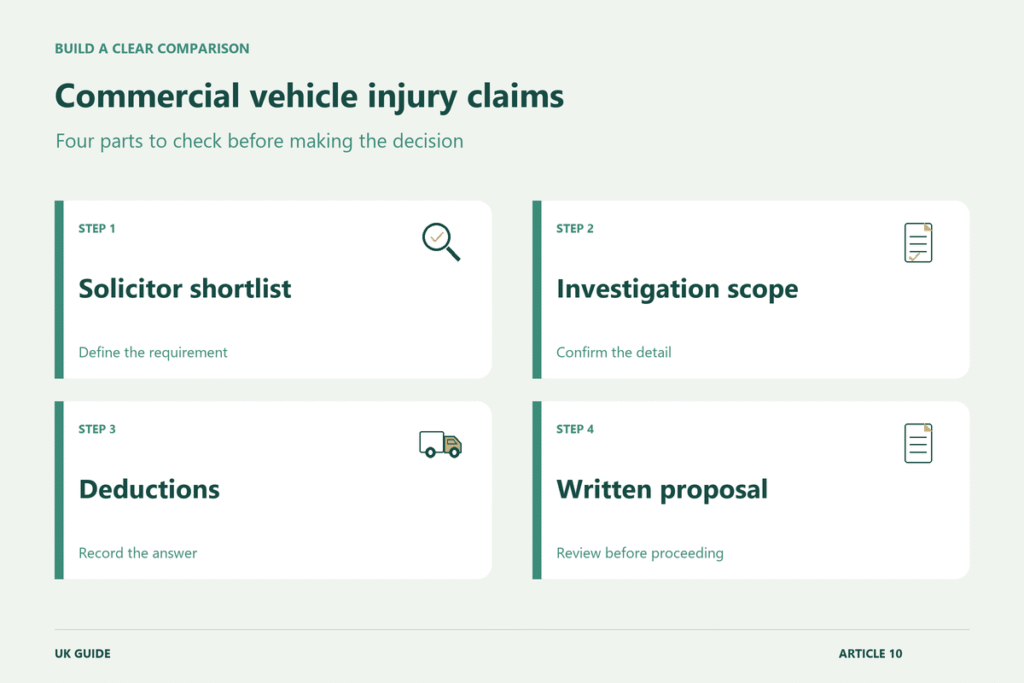
Separate confirmed information from impressions. Written scope, disclosed charges and an identified delivery team belong in the first group. A persuasive conversation or an attractive website belongs in the second. Both can influence your experience, but they should not carry the same weight. Where an answer is missing, leave a visible gap rather than filling it with an optimistic assumption. Ask a follow-up question that could resolve the uncertainty.
Finally, test your preferred option against a plausible difficulty: a delay, a change in scope, an unavailable contact or an unexpected additional cost. Ask how the agreement would handle that situation. This can reveal important differences that a simple price ranking hides. Choose the option whose commitments and limitations you understand, and record why it fits your needs. If the essential information is still missing, improve the comparison before treating the shortlist as a final decision.
Apply the comparison to your location
UK-wide marketing can conceal differences between the services available in England, Wales, Scotland and Northern Ireland. Identify the nation relevant to your circumstances and ask the provider to explain any local limitations. Where regulation applies, check the appropriate register and the firm’s contact details independently. Registration is a starting check, not a promise of a particular outcome. Ask whether the quoted amount includes VAT where applicable, which organisation would take your payment and which complaints process applies to that specific service.
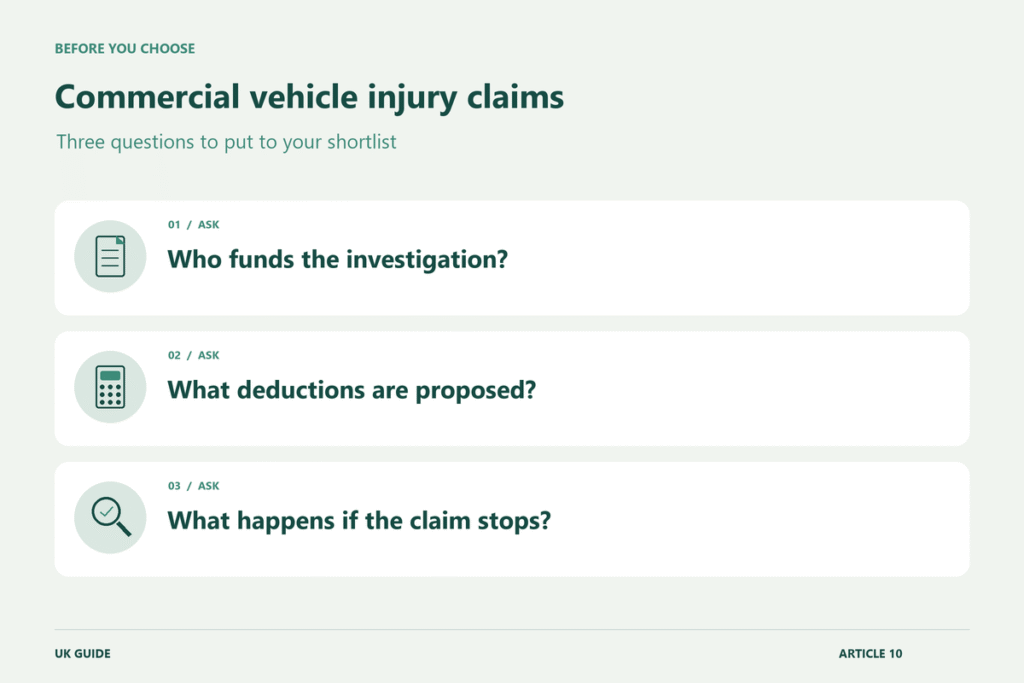
Questions to put to your shortlist
- Who funds the investigation?
- What deductions are proposed?
- What happens if the claim stops?
A point that is easy to miss
A funding comparison is only useful when it describes the same case and jurisdiction. Ask each solicitor to explain the assumptions behind the proposal in writing.
Put the comparison into practice
Compare funding and investigation as one proposal. A solicitor offering a low headline deduction may anticipate different outside work from another team, or may describe separate charges differently. Ask both firms to explain the same hypothetical investigation requirement and show where it falls in their agreements. Leave the cost unresolved if the answer is only a slogan.
Ask who would provide the funding explanation after you instruct the firm, particularly if a different person handles the sales conversation. Establish when updated information about expenses would arrive and who can authorise a change. Consider how the arrangement works if evidence weakens the claim or you wish to stop. Understanding those circumstances is more useful than choosing a proposal based solely on the most optimistic example of a successful outcome.
Make the final decision from the written offer
Request a proposal that reflects the circumstances you actually discussed. Check the name of the contracting organisation, the work included, the charging basis and the person responsible for answering questions. Resolve any important difference between the conversation and the documents before proceeding. Keep a dated copy of the version you accept. If an essential assumption remains uncertain, ask what evidence would settle it and how that uncertainty could affect your next step.
Further reading
Related reading
- How to Choose a Solicitor for an HGV Accident Claim (UK)
- Truck Accident Law Firms: Comparing Investigations, Experts and Legal Support (USA)
- Commercial Vehicle Accident Attorney Fees: What to Compare Before Hiring (USA)
- How to Choose a Truck Accident Lawyer After a Serious Collision (USA)
Explore more in Truck and Commercial Vehicle Accidents.