A medical malpractice lawyer should be able to explain how records and clinical questions would be assessed before offering a conclusion. Compare the proposed review, the lawyer responsible and the financial arrangement. An advertisement about a similar procedure does not establish that your circumstances support a claim.
The decision this article helps you make
Bring a factual care timeline and ask what information the firm needs next. Compare how clearly candidates explain the difference between an initial concern and a supported legal assessment.
Separate a concern about care from a legal assessment
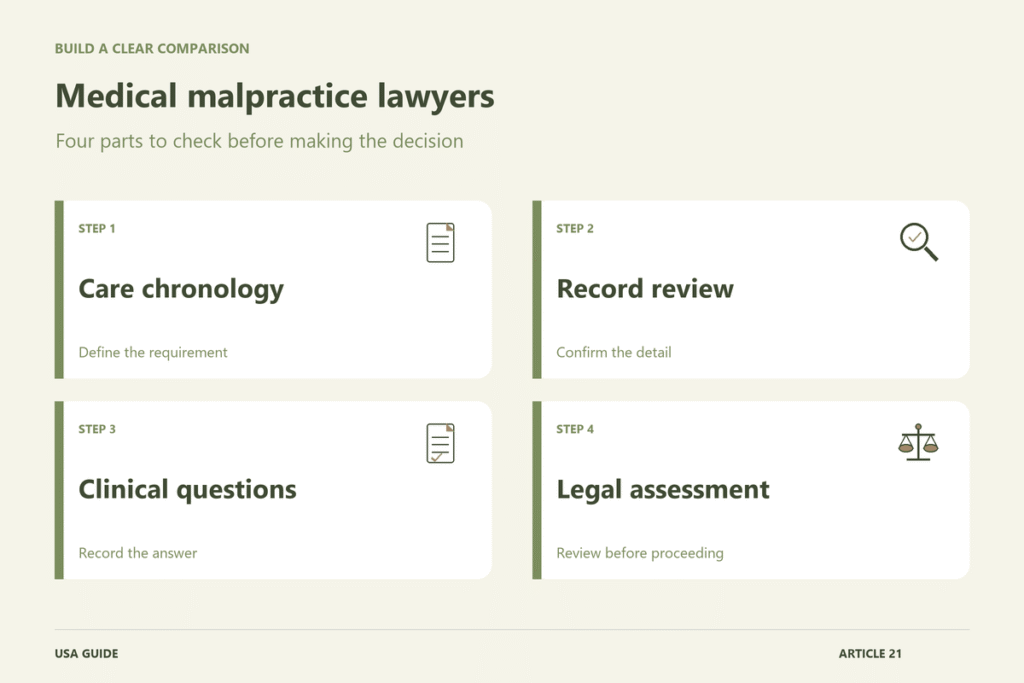
Prepare a chronology of the care received, the concern you want assessed and the effects you experienced. Identify the records already available and the questions you want a professional to investigate. An upsetting outcome does not, on its own, answer the legal questions. Ask the legal team to explain the assessment required without expecting a general article or a brief intake conversation to determine liability.
Ask how medical evidence would be reviewed
Find out who would organise records and decide whether independent clinical expertise is needed. Ask how the team would identify the relevant speciality and explain the questions put to an expert. You do not need to interpret technical records yourself to compare firms. You do need an understandable explanation of the investigative steps, their purpose and the points at which the assessment could change.
Compare funding with the proposed investigation
Medical evidence work can create questions about outside spending and the scope of representation. Ask which costs are anticipated, who approves them and how they would be treated if the matter does not proceed. Request an explanation of any separate funding arrangements rather than assuming that all work is covered by the same advertising slogan. Keep questions about legal costs distinct from decisions about your ongoing healthcare.
Check who will explain difficult findings
Ask how the team communicates when expert opinion does not support an initial concern or when further information is needed. A credible service should make room for uncertainty and unwelcome findings. Compare the named lawyer’s role, supervision and accessibility, particularly if the person affected needs communication support. Seek clinical advice for treatment decisions; selecting a legal representative is a separate task from determining which medical care is appropriate.
Test the provider before making the commitment
Turn the first conversation into a practical assessment. Describe your circumstances briefly, then ask the provider to explain its proposed approach, the information still missing and the next decision you would face. A useful explanation separates what can be confirmed now from what needs investigation. Record those answers immediately so that confident presentation does not become a substitute for substance when you compare candidates later.
Ask who would actually do the work. The person who handles an initial enquiry may have a different role from the person responsible for delivery. Find out how you would reach the responsible professional, what happens during an absence and when progress updates would arrive. Request examples of the documents or reports you would receive, with identifying information removed. This tests the service you would experience rather than the quality of the sales pitch.
Then examine the conditions for leaving. Ask how records, work already completed, outstanding charges and any ongoing responsibilities would be handled if the relationship ended. The answer matters even when you expect to stay. A provider that can explain its boundaries, handover arrangements and unresolved issues gives you a more usable basis for selection than one that simply promises an effortless outcome.
Apply the comparison to your location
Use the state relevant to your situation when checking a provider’s qualifications and the terms of an offer. A national advertisement does not establish that the advertised service is available on the same terms where you live. Record the legal name of the organisation you would contract with, the office responsible for delivery and the date of its proposal. Ask which state-specific conditions affect your comparison. Keep personal identifiers out of initial comparison emails; use a verified secure channel when supporting documents are actually needed.
Questions to put to your shortlist
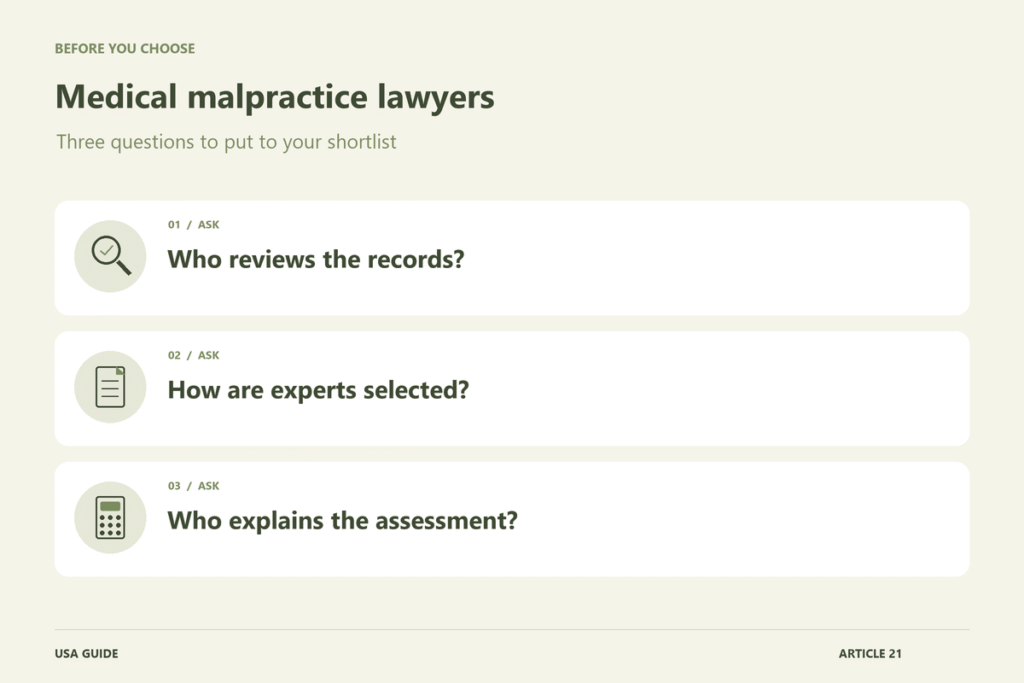
- Who reviews the records?
- How are experts selected?
- Who explains the assessment?
A point that is easy to miss
A consultation is a starting point for investigation. Ask what remains unknown and avoid treating acceptance of an enquiry as confirmation that the legal merits have been established.
Put the comparison into practice
Ask how the firm would move from receiving your chronology to deciding whether a detailed clinical review is justified. The answer should identify the professional roles involved and the information needed, while making room for uncertainty. A lawyer should not need to promise that a concern is legally supported in order to explain a competent assessment process.
Compare the way candidates discuss unwelcome findings. Ask how you would learn that expert opinion does not support further action and what explanation you would receive. Clarify the financial position if that happens. This question tests both communication and the cost arrangement. Keep the legal enquiry separate from current care decisions: the lawyer’s role in assessing a possible claim is different from a clinician’s role in recommending treatment for your present needs.
Make the final decision from the written offer
Request a proposal that reflects the circumstances you actually discussed. Check the name of the contracting organisation, the work included, the charging basis and the person responsible for answering questions. Resolve any important difference between the conversation and the documents before proceeding. Keep a dated copy of the version you accept. If an essential assumption remains uncertain, ask what evidence would settle it and how that uncertainty could affect your next step.
Further reading
Related reading
- Medical Malpractice Attorney Fees: Expert Witness Costs and Legal Expenses (USA)
- Birth Injury Law Firms: What Families Should Compare Before Hiring (USA)
- Clinical Negligence Solicitors: Comparing Fees, Funding and Experience (UK)
- Private Hospital Negligence Claims: Choosing a Specialist Solicitor (UK)
Explore more in Medical Malpractice and Clinical Negligence.