Private health insurance should be compared using the cover, restrictions and provider access offered to you. Ask how the insurer assesses relevant history and which costs you would still pay. Hospital access is one part of the comparison, not a guarantee that every service at a named hospital is covered.
The decision this article helps you make
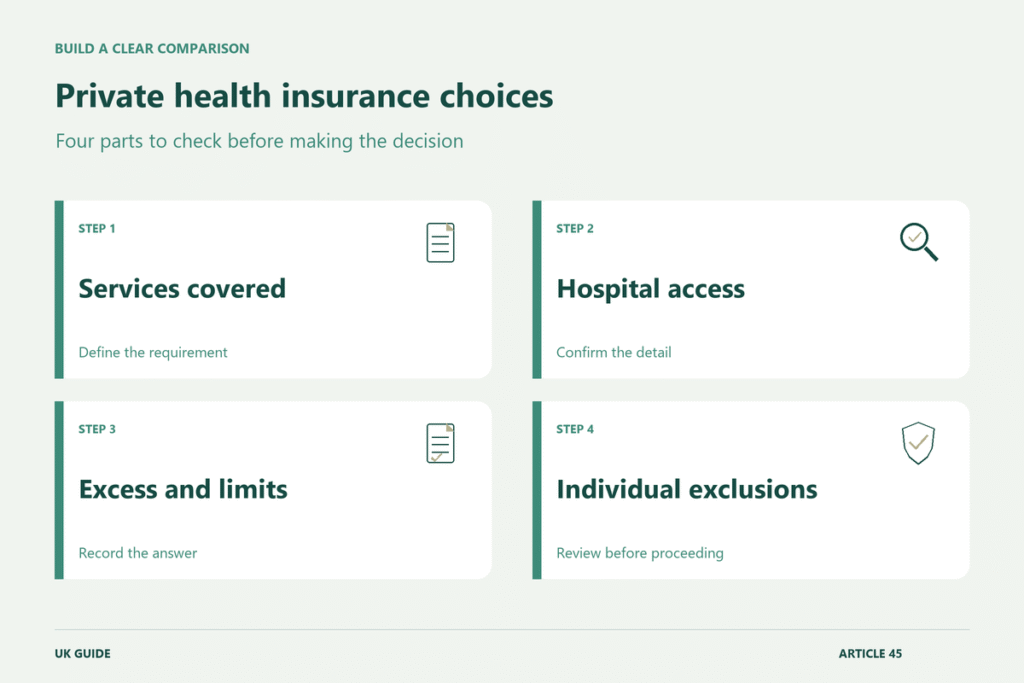
Examine the policy’s treatment of consultations, tests and treatment alongside the excess. Ask about any changes in terms when replacing an existing policy before relying on a premium saving.
Define the risk before comparing premiums
Write down what you need the policy to protect and the financial loss you are trying to manage. Identify the people, activities, property or circumstances that matter to the application. Use the same accurate information for each quote and ask an insurer or broker about any detail you are uncertain how to describe. A low premium is not a useful saving if the proposal is based on a different risk from yours.
Read the coverage alongside the exclusions
Compare the policy wording, limits, deductible or excess, and conditions affecting a claim. Ask which events are outside the proposed cover and which optional additions would change the premium. Have the provider explain a realistic example that matters to you, including the part you would need to fund yourself. Do not infer that two policies are equivalent because they share a familiar product name.
Establish who supplies and services the policy
Identify the insurer, the broker if there is one, and the organisation responsible for handling a claim. Ask about the broker’s role and any separate fees. Check the relevant licensing or regulatory information independently. Where an existing policy is involved, ask how a change would be coordinated and which dates, conditions or disclosures need attention before you rely on replacement cover.
Compare the ongoing arrangement
Ask how renewal, cancellation, changes to the insured circumstances and claim reporting would work. Request a written explanation of any condition you would find difficult to meet. Store the application information and policy documents together so that the coverage can be checked later. A useful final choice balances the premium with the cover you understand, the amount you could afford to pay yourself and the responsibilities you would take on under the contract.
Examine what the package actually includes
Translate every broad description into an observable deliverable. Words such as comprehensive, premium and fully managed are not a substitute for an explanation of what the organisation will do. Ask for the tasks, the responsible people, the expected output and any conditions that limit delivery. The objective is to make the offer specific enough that you can recognise both completion and an omission.
Look carefully at the boundary between the main provider and third parties. A package may depend on another professional, a separate supplier or a product with its own terms. Ask who selects that third party, who receives the invoice and who responds if something goes wrong. Identify which commitments belong in your main agreement and which require separate confirmation. Do not assume that a referral automatically includes responsibility for the referred service.
Then check how changes are handled. Ask whether additional work needs your approval, how its price would be disclosed and what happens if you decline. A package can still be useful when it has exclusions, provided those exclusions are understandable and compatible with your needs. Compare the proposed scope against your own requirements rather than rewarding the longest feature list. Pay particular attention to the part of the service you would find hardest to replace yourself.
Apply the comparison to your location
UK-wide marketing can conceal differences between the services available in England, Wales, Scotland and Northern Ireland. Identify the nation relevant to your circumstances and ask the provider to explain any local limitations. Where regulation applies, check the appropriate register and the firm’s contact details independently. Registration is a starting check, not a promise of a particular outcome. Ask whether the quoted amount includes VAT where applicable, which organisation would take your payment and which complaints process applies to that specific service.
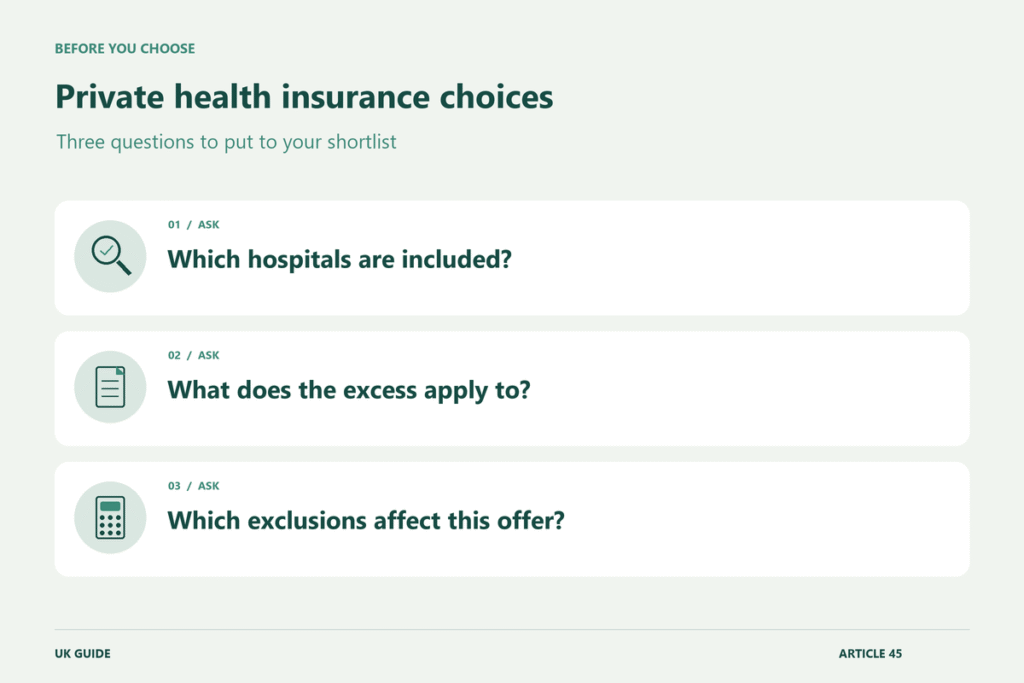
Questions to put to your shortlist
- Which hospitals are included?
- What does the excess apply to?
- Which exclusions affect this offer?
A point that is easy to miss
A hospital’s presence on a list does not establish coverage for every consultant, test or treatment. Ask the insurer to explain the conditions relevant to the care you may seek.
Put the comparison into practice
Start with the services you want the insurer to explain, such as outpatient appointments, diagnostic work or hospital treatment. Ask how the proposal addresses each and what limits or authorisation requirements apply. Do not assume that inclusion of a hospital on a list establishes cover for every consultant, procedure or related charge.
Compare the excess and exclusions alongside the premium, including how the insurer assesses history relevant to the application. If replacing existing cover, request a specific explanation of the new terms and the timing of the change. Treat a premium saving as provisional until the protection offered is understood. Keep policy selection separate from clinical advice: an insurance package describes financial cover under its terms, not which care is appropriate for an individual patient.
Further reading
Related reading
- Public Liability Insurance for Builders: Comparing Quotes and Exclusions (UK)
- Term Life Insurance Quotes: How to Compare Insurers and Coverage (USA)
- Professional Liability Insurance for Consultants: Comparing Policy Quotes (USA)
- Commercial Truck Insurance Quotes: Comparing Coverage, Deductibles and Costs (USA)
Explore more in Insurance.