Business loan lenders should be compared against a defined financing need. Ask how much cash reaches the business, when payments are due and what obligations accompany the funding. The lowest advertised rate may not describe the offer available to your company or the total borrowing cost.
The decision this article helps you make
Compare the repayment schedule, fees, security and any guarantee using the same amount and intended use. Ask lenders to explain differences between a preliminary quote and an assessed offer.
Define the borrowing requirement
Identify the purpose of the borrowing, the amount actually needed and the repayment pattern you could sustain. For a business, distinguish a one-off purchase from a continuing cash-flow need. For personal borrowing, consider the budget after existing commitments and essential spending. A provider’s willingness to offer a larger amount does not establish that taking it would be suitable for your needs.
Compare the complete repayment structure
Request the amount you would receive, the payment schedule, interest or other charging basis, fees and total amount payable. Ask how variable charges, late payments and early repayment would affect the calculation. Where an offer is not expressed as a conventional interest rate, request a clear explanation of the effective borrowing cost. Do not compare a factor rate, a monthly charge and an APR as though they were the same measurement.
Understand security and personal obligations
Ask whether the proposal involves collateral, a personal guarantee or other rights over assets. Have the lender explain what would happen if payments could not be maintained. Business and consumer products can differ in their terms and protections, so ask which type of agreement you are considering. The purpose of the comparison is to understand the commitment before signing, not simply to obtain the fastest approval.
Check the offer and the provider
Distinguish a preliminary quotation from an offer based on a completed assessment. Ask whether an application involves a credit search, who the actual lender is and whether a broker receives a separate fee. Verify relevant authorisation where it applies and confirm contact details independently. Keep the proposal and disclosures together, and review your repayment assumptions if circumstances change before funds are drawn.
Compare the alternatives on the same basis
Choose the decision criteria before looking at promotional claims. Write down the outcome you need, the constraints you cannot change and the circumstances that would make an option unsuitable. Send the same basic requirements to each organisation. Otherwise, you may spend time comparing answers to different questions. A short comparison with clear assumptions is more useful than a long list of features that do not affect your decision.
Separate confirmed information from impressions. Written scope, disclosed charges and an identified delivery team belong in the first group. A persuasive conversation or an attractive website belongs in the second. Both can influence your experience, but they should not carry the same weight. Where an answer is missing, leave a visible gap rather than filling it with an optimistic assumption. Ask a follow-up question that could resolve the uncertainty.
Finally, test your preferred option against a plausible difficulty: a delay, a change in scope, an unavailable contact or an unexpected additional cost. Ask how the agreement would handle that situation. This can reveal important differences that a simple price ranking hides. Choose the option whose commitments and limitations you understand, and record why it fits your needs. If the essential information is still missing, improve the comparison before treating the shortlist as a final decision.
Apply the comparison to your location
Use the state relevant to your situation when checking a provider’s qualifications and the terms of an offer. A national advertisement does not establish that the advertised service is available on the same terms where you live. Record the legal name of the organisation you would contract with, the office responsible for delivery and the date of its proposal. Ask which state-specific conditions affect your comparison. Keep personal identifiers out of initial comparison emails; use a verified secure channel when supporting documents are actually needed.
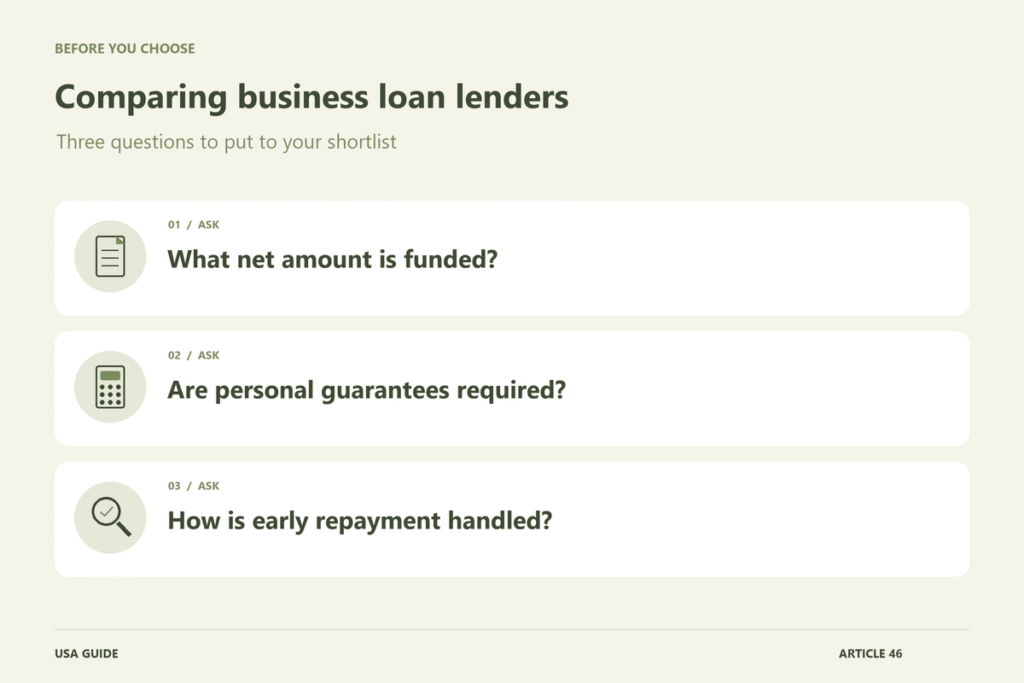
Questions to put to your shortlist
- What net amount is funded?
- Are personal guarantees required?
- How is early repayment handled?
A point that is easy to miss
Fast funding is useful only if the repayment commitment works for the business. Test the schedule against a weaker trading period instead of using the best month as your only assumption.
Put the comparison into practice
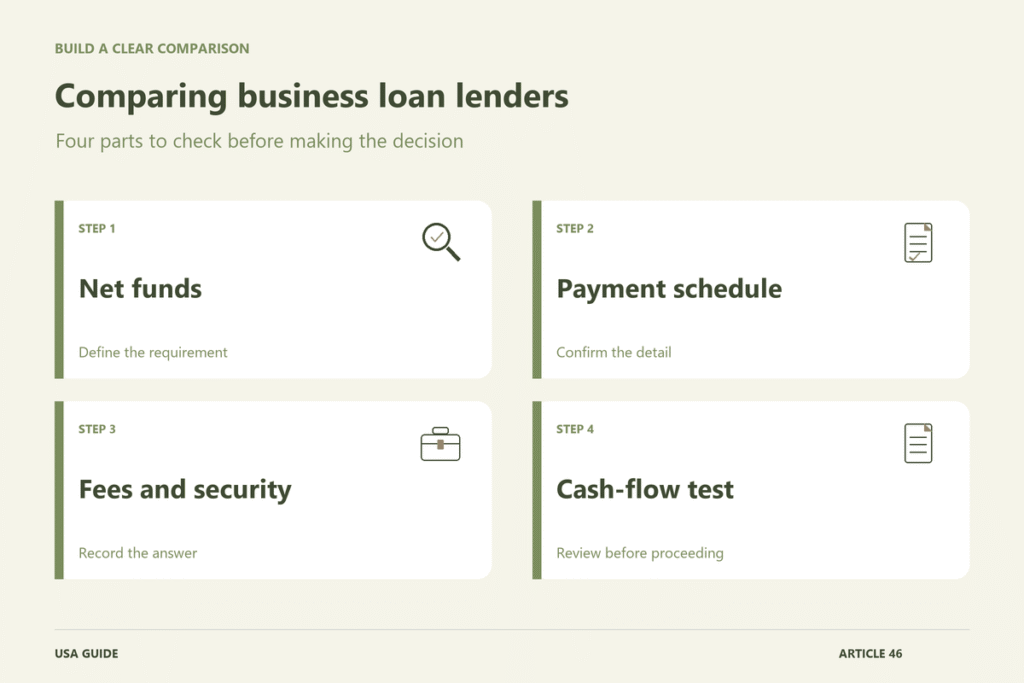
Construct a business borrowing comparison using the net funds received, payment dates, fees, security and guarantees. Use the same requested amount and purpose so that differences between lenders are visible. Ask each provider to distinguish the advertised product from the offer based on your business’s assessment.
Stress-test the repayment schedule against a plausible period of weaker receipts, without assuming a sales forecast will be achieved. Ask how late payment, early repayment and changes to the facility would be handled. A fast approval does not resolve those questions. If a broker is involved, identify the actual lender and any separately payable charges. Compare the complete commitment with other appropriate funding routes before treating the highest available loan amount as the right amount to borrow.
Further reading
Related reading
- Debt Consolidation Loans: Comparing APRs and Total Repayment Costs (USA)
- Business Lines of Credit: Comparing Banks and Online Lenders (USA)
- Secured Loan Brokers: Comparing Fees and Lender Options (UK)
- Business Acquisition Loans: Comparing Lenders and Finance Structures (UK)
Explore more in Loans.