A debt consolidation loan should be evaluated against the debts it would replace, including the repayment period and total cost. A lower monthly payment can arise from spreading payments over longer. Compare the complete schedule rather than assuming that a smaller payment automatically produces a saving.
The decision this article helps you make
List balances, current costs and proposed replacement payments. Ask about origination charges and the amount actually available to clear existing debts, then check whether the new commitment fits your budget.
Define the borrowing requirement
Identify the purpose of the borrowing, the amount actually needed and the repayment pattern you could sustain. For a business, distinguish a one-off purchase from a continuing cash-flow need. For personal borrowing, consider the budget after existing commitments and essential spending. A provider’s willingness to offer a larger amount does not establish that taking it would be suitable for your needs.
Compare the complete repayment structure
Request the amount you would receive, the payment schedule, interest or other charging basis, fees and total amount payable. Ask how variable charges, late payments and early repayment would affect the calculation. Where an offer is not expressed as a conventional interest rate, request a clear explanation of the effective borrowing cost. Do not compare a factor rate, a monthly charge and an APR as though they were the same measurement.
Understand security and personal obligations
Ask whether the proposal involves collateral, a personal guarantee or other rights over assets. Have the lender explain what would happen if payments could not be maintained. Business and consumer products can differ in their terms and protections, so ask which type of agreement you are considering. The purpose of the comparison is to understand the commitment before signing, not simply to obtain the fastest approval.
Check the offer and the provider
Distinguish a preliminary quotation from an offer based on a completed assessment. Ask whether an application involves a credit search, who the actual lender is and whether a broker receives a separate fee. Verify relevant authorisation where it applies and confirm contact details independently. Keep the proposal and disclosures together, and review your repayment assumptions if circumstances change before funds are drawn.
Build a complete cost comparison
Start with a written breakdown rather than a headline amount. Separate the initial commitment, the main charge, payments to other organisations and any optional additions. Ask which figures are fixed, which are estimates and which depend on decisions that have not been made. Put the assumptions beside the numbers. Two apparently different prices may describe different amounts of work, while two identical prices may leave you with very different obligations.
Next, ask the provider to walk through a realistic change in circumstances. What happens if the work takes longer, an additional service becomes necessary or you decide to stop? Request an explanation of how a revised price would be approved and when you would be told. Do not treat an unknown amount as zero simply because it is missing from a quotation. Mark it as unresolved until you receive a useful answer.
Compare the total commitment over the period that matters to you. An introductory saving may be outweighed by later charges; an apparently expensive proposal may include work that another proposal bills separately. The aim is to understand those differences, not to make every offer look identical. Keep the original proposal, the provider’s clarifications and the final agreement together so that you can check what changed before authorising payment or signing.
Apply the comparison to your location
Use the state relevant to your situation when checking a provider’s qualifications and the terms of an offer. A national advertisement does not establish that the advertised service is available on the same terms where you live. Record the legal name of the organisation you would contract with, the office responsible for delivery and the date of its proposal. Ask which state-specific conditions affect your comparison. Keep personal identifiers out of initial comparison emails; use a verified secure channel when supporting documents are actually needed.
Questions to put to your shortlist
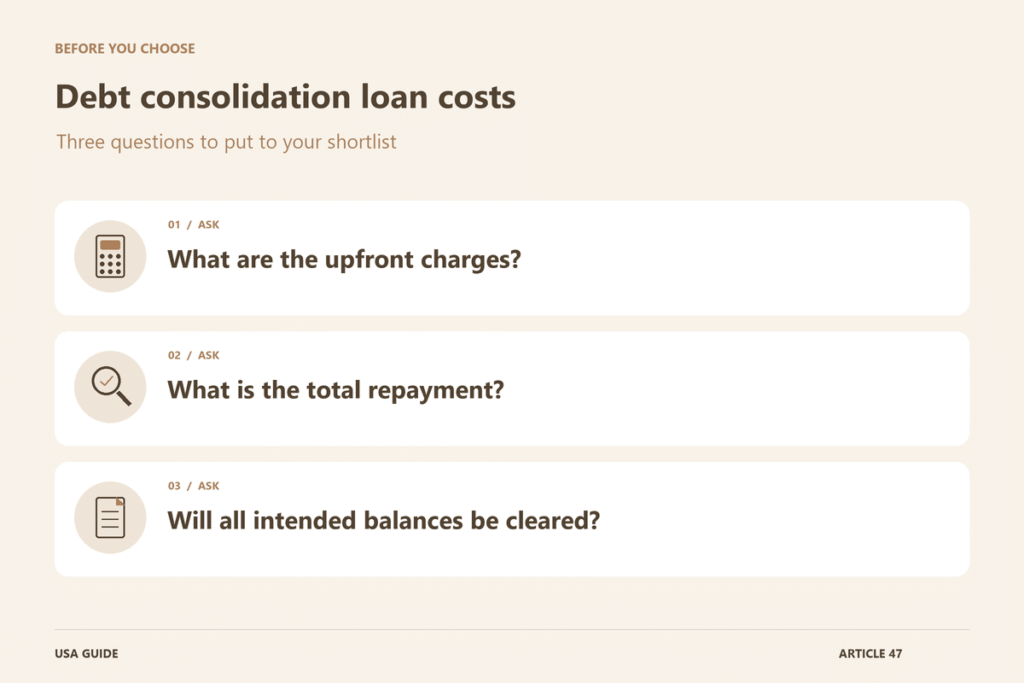
- What are the upfront charges?
- What is the total repayment?
- Will all intended balances be cleared?
A point that is easy to miss
Consolidating balances does not remove the underlying borrowing. Include a plan for avoiding additional debt and seek independent help if the proposed payment remains unaffordable.
Put the comparison into practice
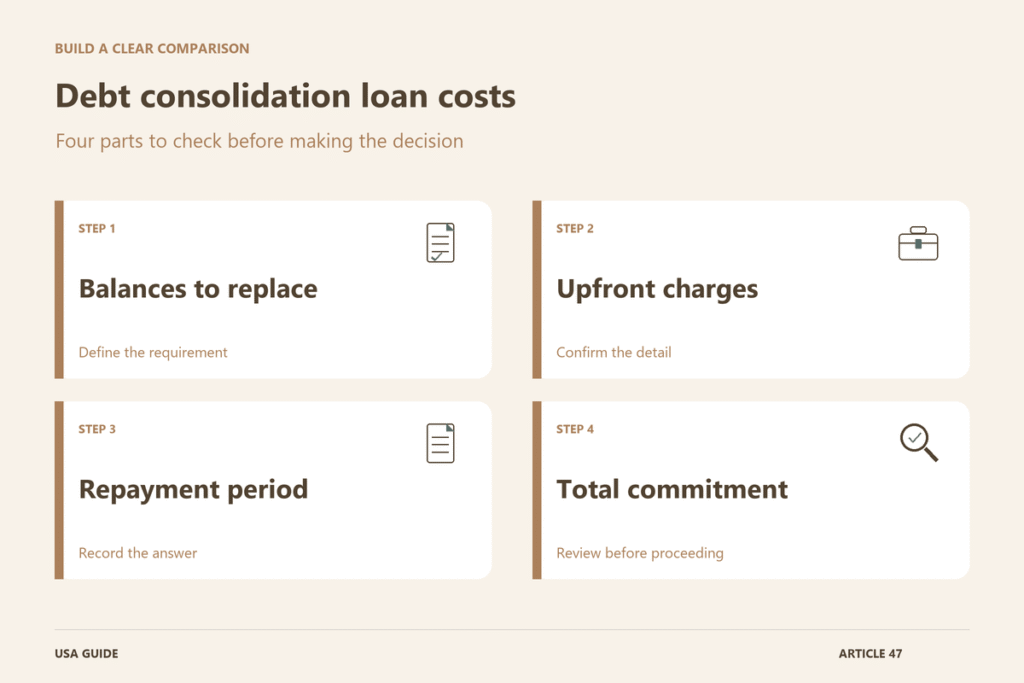
Create a before-and-after schedule listing the balances to be replaced, the cash available from the proposed loan and the intended repayment period. Include any fee that reduces the amount received or increases the balance. A consolidation proposal is not directly comparable if it leaves some intended debts outstanding without making that difference clear.
Compare both monthly affordability and the overall repayment commitment. If the payment is lower because the term is longer, ask how that changes total cost and the time spent in debt. Consider what would prevent the cleared accounts from building up again. Where the new payment still does not fit the budget, seek independent debt guidance rather than assuming a larger consolidation loan solves the underlying problem or removes the need to address future spending.
Further reading
Related reading
- Business Loan Lenders: Comparing Rates, Fees and Funding Terms (USA)
- Business Lines of Credit: Comparing Banks and Online Lenders (USA)
- Secured Loan Brokers: Comparing Fees and Lender Options (UK)
- Business Acquisition Loans: Comparing Lenders and Finance Structures (UK)
Explore more in Loans.