A business line of credit should match how the company expects to draw and repay funds. Compare the available limit with access fees, ongoing charges and the conditions attached to borrowing. An unused limit is not a complete description of the financial commitment.
The decision this article helps you make
Ask how each draw is priced, when repayment begins and whether access can change. Compare the lender’s explanation with the pattern of expenses and receipts the facility is intended to support.
Define the borrowing requirement
Identify the purpose of the borrowing, the amount actually needed and the repayment pattern you could sustain. For a business, distinguish a one-off purchase from a continuing cash-flow need. For personal borrowing, consider the budget after existing commitments and essential spending. A provider’s willingness to offer a larger amount does not establish that taking it would be suitable for your needs.
Compare the complete repayment structure
Request the amount you would receive, the payment schedule, interest or other charging basis, fees and total amount payable. Ask how variable charges, late payments and early repayment would affect the calculation. Where an offer is not expressed as a conventional interest rate, request a clear explanation of the effective borrowing cost. Do not compare a factor rate, a monthly charge and an APR as though they were the same measurement.
Understand security and personal obligations
Ask whether the proposal involves collateral, a personal guarantee or other rights over assets. Have the lender explain what would happen if payments could not be maintained. Business and consumer products can differ in their terms and protections, so ask which type of agreement you are considering. The purpose of the comparison is to understand the commitment before signing, not simply to obtain the fastest approval.
Check the offer and the provider
Distinguish a preliminary quotation from an offer based on a completed assessment. Ask whether an application involves a credit search, who the actual lender is and whether a broker receives a separate fee. Verify relevant authorisation where it applies and confirm contact details independently. Keep the proposal and disclosures together, and review your repayment assumptions if circumstances change before funds are drawn.
Examine what the package actually includes
Translate every broad description into an observable deliverable. Words such as comprehensive, premium and fully managed are not a substitute for an explanation of what the organisation will do. Ask for the tasks, the responsible people, the expected output and any conditions that limit delivery. The objective is to make the offer specific enough that you can recognise both completion and an omission.
Look carefully at the boundary between the main provider and third parties. A package may depend on another professional, a separate supplier or a product with its own terms. Ask who selects that third party, who receives the invoice and who responds if something goes wrong. Identify which commitments belong in your main agreement and which require separate confirmation. Do not assume that a referral automatically includes responsibility for the referred service.
Then check how changes are handled. Ask whether additional work needs your approval, how its price would be disclosed and what happens if you decline. A package can still be useful when it has exclusions, provided those exclusions are understandable and compatible with your needs. Compare the proposed scope against your own requirements rather than rewarding the longest feature list. Pay particular attention to the part of the service you would find hardest to replace yourself.
Apply the comparison to your location
Use the state relevant to your situation when checking a provider’s qualifications and the terms of an offer. A national advertisement does not establish that the advertised service is available on the same terms where you live. Record the legal name of the organisation you would contract with, the office responsible for delivery and the date of its proposal. Ask which state-specific conditions affect your comparison. Keep personal identifiers out of initial comparison emails; use a verified secure channel when supporting documents are actually needed.
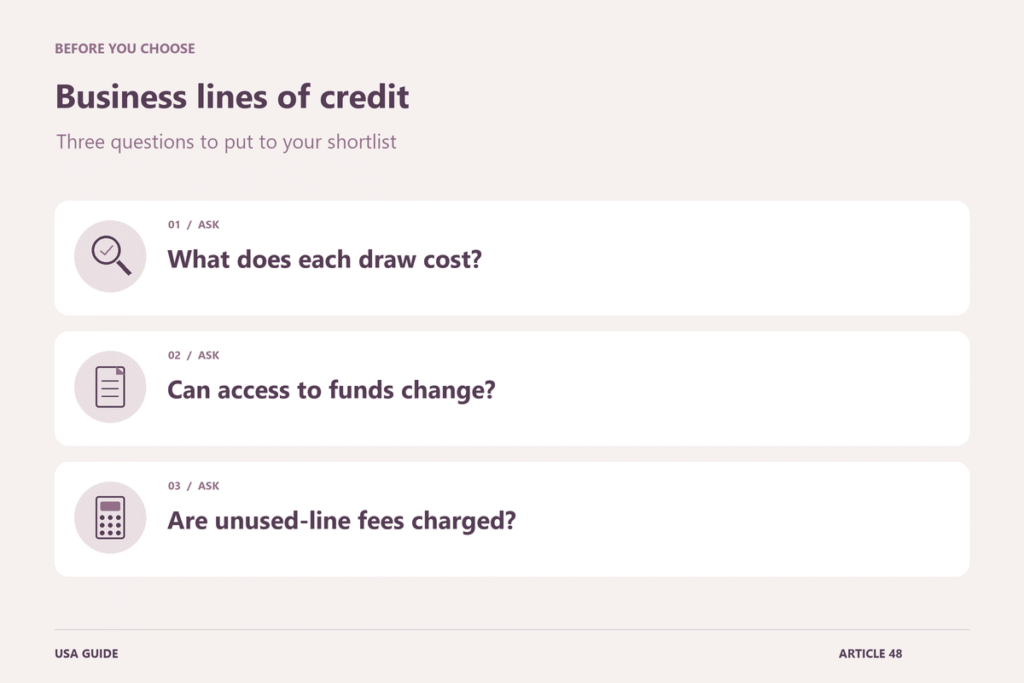
Questions to put to your shortlist
- What does each draw cost?
- Can access to funds change?
- Are unused-line fees charged?
A point that is easy to miss
Flexibility has to be assessed from the agreement. Ask about review, renewal and withdrawal conditions rather than assuming the full advertised limit will always remain available.
Put the comparison into practice
Map how your business expects to use the line: when funds would be drawn, how long they would remain outstanding and which receipts would support repayment. Ask lenders to price that pattern rather than comparing an unused headline limit. Include draw charges, recurring fees and any conditions for maintaining availability.
Ask how review, renewal or a change in your circumstances could affect access. Establish whether each draw has its own repayment schedule and how variable pricing is explained. Compare a planned use with a less favourable scenario in which receipts arrive late. The purpose is to assess flexibility that the agreement actually provides. A limit presented during marketing or prequalification should not be treated as guaranteed access to cash under every future trading condition.
Make the final decision from the written offer
Request a proposal that reflects the circumstances you actually discussed. Check the name of the contracting organisation, the work included, the charging basis and the person responsible for answering questions. Resolve any important difference between the conversation and the documents before proceeding. Keep a dated copy of the version you accept. If an essential assumption remains uncertain, ask what evidence would settle it and how that uncertainty could affect your next step.
Further reading
Related reading
- Debt Consolidation Loans: Comparing APRs and Total Repayment Costs (USA)
- Business Loan Lenders: Comparing Rates, Fees and Funding Terms (USA)
- Secured Loan Brokers: Comparing Fees and Lender Options (UK)
- Business Acquisition Loans: Comparing Lenders and Finance Structures (UK)
Explore more in Loans.