A secured loan broker should explain the proposed borrowing, its own role and the fees connected with arranging it. Ask which lenders it considers and what security the agreement would involve. The comparison should make the commitment understandable before you focus on an approval estimate.
The decision this article helps you make
Request a breakdown of broker and lender charges and ask whether those amounts are added to the borrowing. Understand the consequences of security and the total repayment before proceeding.
Define the borrowing requirement
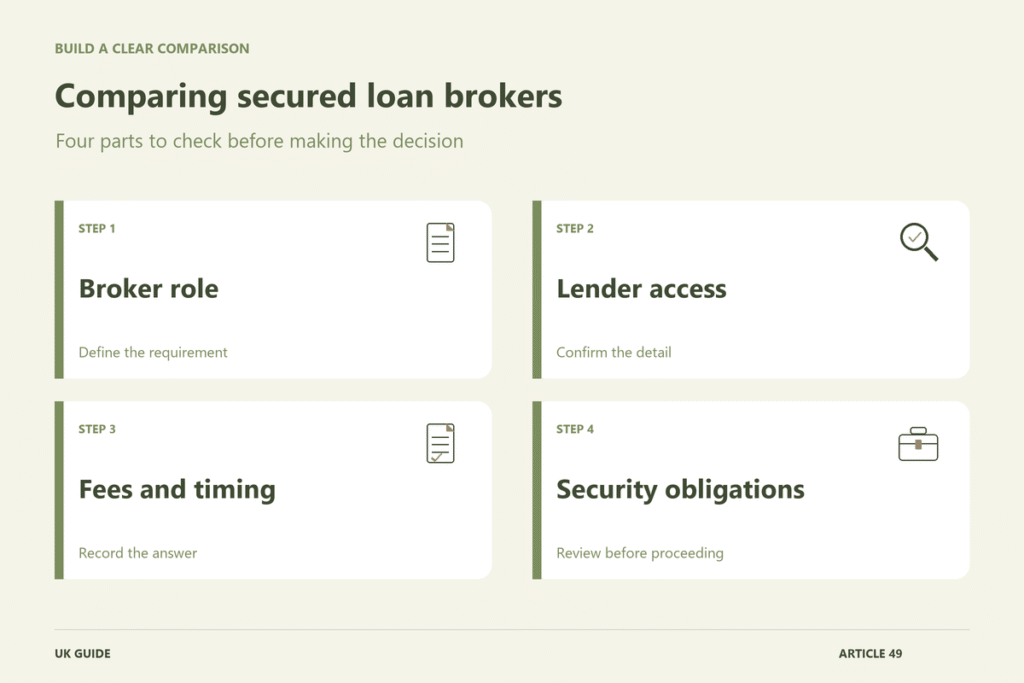
Identify the purpose of the borrowing, the amount actually needed and the repayment pattern you could sustain. For a business, distinguish a one-off purchase from a continuing cash-flow need. For personal borrowing, consider the budget after existing commitments and essential spending. A provider’s willingness to offer a larger amount does not establish that taking it would be suitable for your needs.
Compare the complete repayment structure
Request the amount you would receive, the payment schedule, interest or other charging basis, fees and total amount payable. Ask how variable charges, late payments and early repayment would affect the calculation. Where an offer is not expressed as a conventional interest rate, request a clear explanation of the effective borrowing cost. Do not compare a factor rate, a monthly charge and an APR as though they were the same measurement.
Understand security and personal obligations
Ask whether the proposal involves collateral, a personal guarantee or other rights over assets. Have the lender explain what would happen if payments could not be maintained. Business and consumer products can differ in their terms and protections, so ask which type of agreement you are considering. The purpose of the comparison is to understand the commitment before signing, not simply to obtain the fastest approval.
Check the offer and the provider
Distinguish a preliminary quotation from an offer based on a completed assessment. Ask whether an application involves a credit search, who the actual lender is and whether a broker receives a separate fee. Verify relevant authorisation where it applies and confirm contact details independently. Keep the proposal and disclosures together, and review your repayment assumptions if circumstances change before funds are drawn.
Test the provider before making the commitment
Turn the first conversation into a practical assessment. Describe your circumstances briefly, then ask the provider to explain its proposed approach, the information still missing and the next decision you would face. A useful explanation separates what can be confirmed now from what needs investigation. Record those answers immediately so that confident presentation does not become a substitute for substance when you compare candidates later.
Ask who would actually do the work. The person who handles an initial enquiry may have a different role from the person responsible for delivery. Find out how you would reach the responsible professional, what happens during an absence and when progress updates would arrive. Request examples of the documents or reports you would receive, with identifying information removed. This tests the service you would experience rather than the quality of the sales pitch.
Then examine the conditions for leaving. Ask how records, work already completed, outstanding charges and any ongoing responsibilities would be handled if the relationship ended. The answer matters even when you expect to stay. A provider that can explain its boundaries, handover arrangements and unresolved issues gives you a more usable basis for selection than one that simply promises an effortless outcome.
Apply the comparison to your location
UK-wide marketing can conceal differences between the services available in England, Wales, Scotland and Northern Ireland. Identify the nation relevant to your circumstances and ask the provider to explain any local limitations. Where regulation applies, check the appropriate register and the firm’s contact details independently. Registration is a starting check, not a promise of a particular outcome. Ask whether the quoted amount includes VAT where applicable, which organisation would take your payment and which complaints process applies to that specific service.
Questions to put to your shortlist
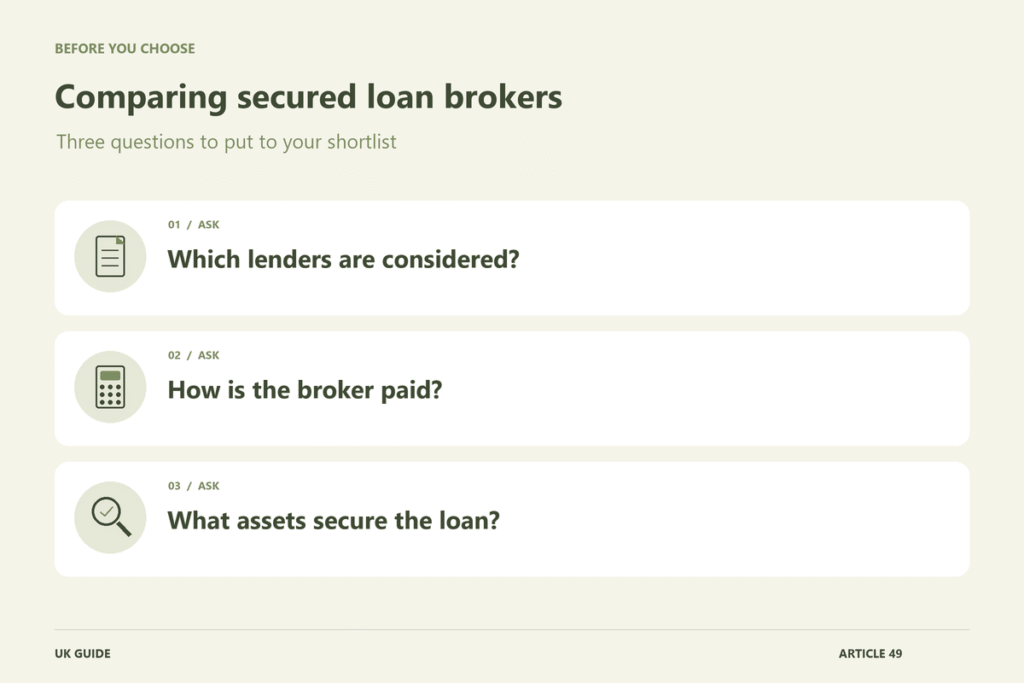
- Which lenders are considered?
- How is the broker paid?
- What assets secure the loan?
A point that is easy to miss
A broker’s recommendation should be assessed alongside the actual lender terms. Ask for clarification if an introduction or arrangement fee is payable even when funding does not complete.
Put the comparison into practice
Ask the broker for a written explanation of its role, the lenders considered and how it is paid. Identify when any broker charge becomes payable and what happens if the proposed borrowing does not complete. Compare that arrangement separately from the lender’s own fees and repayment terms.
Have the security and default implications explained in language you understand, obtaining appropriate independent advice where needed. Ask what property or assets are involved and how the proposal changes your overall obligations. If a fee is added to the borrowing, include its effect on the amount repaid rather than treating it as a charge that disappeared. A recommendation should fit the actual need and affordability assessment, not merely the amount a lender may be willing to offer.
Make the final decision from the written offer
Request a proposal that reflects the circumstances you actually discussed. Check the name of the contracting organisation, the work included, the charging basis and the person responsible for answering questions. Resolve any important difference between the conversation and the documents before proceeding. Keep a dated copy of the version you accept. If an essential assumption remains uncertain, ask what evidence would settle it and how that uncertainty could affect your next step.
Further reading
Related reading
- Business Acquisition Loans: Comparing Lenders and Finance Structures (UK)
- Business Lines of Credit: Comparing Banks and Online Lenders (USA)
- Debt Consolidation Loans: Comparing APRs and Total Repayment Costs (USA)
- Business Loan Lenders: Comparing Rates, Fees and Funding Terms (USA)
Explore more in Loans.