
A concern about care in a private hospital calls for an assessment of the actual treatment, records and parties involved. Ask a prospective solicitor what it would investigate before identifying a legal route. Compare the evidence plan and representation offered rather than treating a hospital brand as the whole case.
The decision this article helps you make
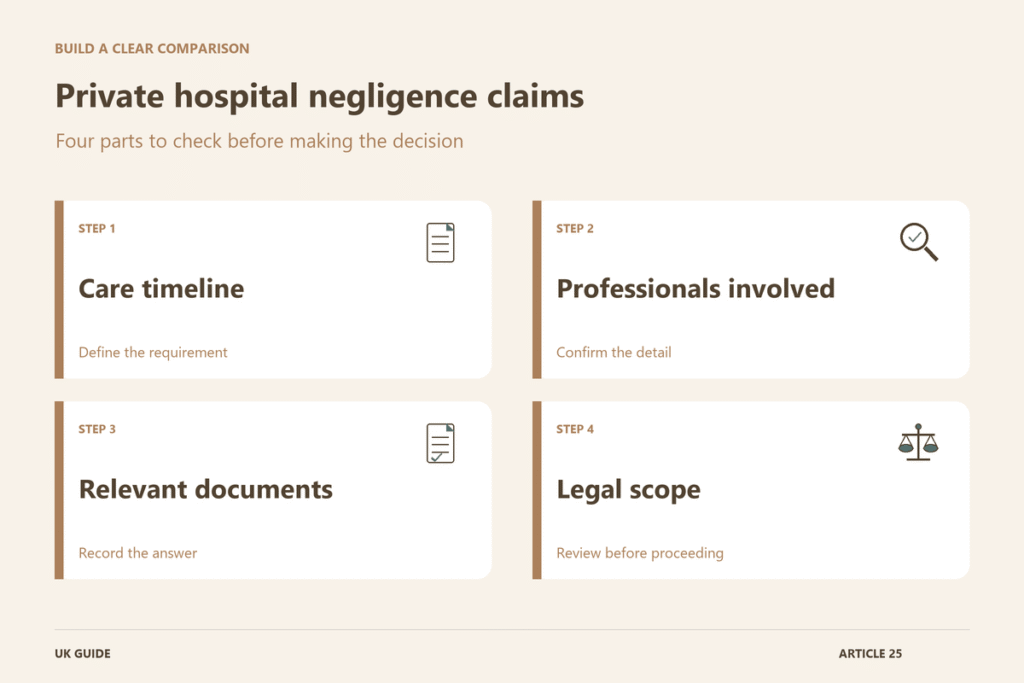
Prepare the treatment timeline and identify the professionals and organisations named in your documents. Ask the solicitor how it would clarify their respective roles without assuming responsibility in advance.
Separate a concern about care from a legal assessment
Prepare a chronology of the care received, the concern you want assessed and the effects you experienced. Identify the records already available and the questions you want a professional to investigate. An upsetting outcome does not, on its own, answer the legal questions. Ask the legal team to explain the assessment required without expecting a general article or a brief intake conversation to determine liability.
Ask how medical evidence would be reviewed
Find out who would organise records and decide whether independent clinical expertise is needed. Ask how the team would identify the relevant speciality and explain the questions put to an expert. You do not need to interpret technical records yourself to compare firms. You do need an understandable explanation of the investigative steps, their purpose and the points at which the assessment could change.
Compare funding with the proposed investigation
Medical evidence work can create questions about outside spending and the scope of representation. Ask which costs are anticipated, who approves them and how they would be treated if the matter does not proceed. Request an explanation of any separate funding arrangements rather than assuming that all work is covered by the same advertising slogan. Keep questions about legal costs distinct from decisions about your ongoing healthcare.
Check who will explain difficult findings
Ask how the team communicates when expert opinion does not support an initial concern or when further information is needed. A credible service should make room for uncertainty and unwelcome findings. Compare the named lawyer’s role, supervision and accessibility, particularly if the person affected needs communication support. Seek clinical advice for treatment decisions; selecting a legal representative is a separate task from determining which medical care is appropriate.
Test the provider before making the commitment
Turn the first conversation into a practical assessment. Describe your circumstances briefly, then ask the provider to explain its proposed approach, the information still missing and the next decision you would face. A useful explanation separates what can be confirmed now from what needs investigation. Record those answers immediately so that confident presentation does not become a substitute for substance when you compare candidates later.
Ask who would actually do the work. The person who handles an initial enquiry may have a different role from the person responsible for delivery. Find out how you would reach the responsible professional, what happens during an absence and when progress updates would arrive. Request examples of the documents or reports you would receive, with identifying information removed. This tests the service you would experience rather than the quality of the sales pitch.
Then examine the conditions for leaving. Ask how records, work already completed, outstanding charges and any ongoing responsibilities would be handled if the relationship ended. The answer matters even when you expect to stay. A provider that can explain its boundaries, handover arrangements and unresolved issues gives you a more usable basis for selection than one that simply promises an effortless outcome.
Apply the comparison to your location
UK-wide marketing can conceal differences between the services available in England, Wales, Scotland and Northern Ireland. Identify the nation relevant to your circumstances and ask the provider to explain any local limitations. Where regulation applies, check the appropriate register and the firm’s contact details independently. Registration is a starting check, not a promise of a particular outcome. Ask whether the quoted amount includes VAT where applicable, which organisation would take your payment and which complaints process applies to that specific service.
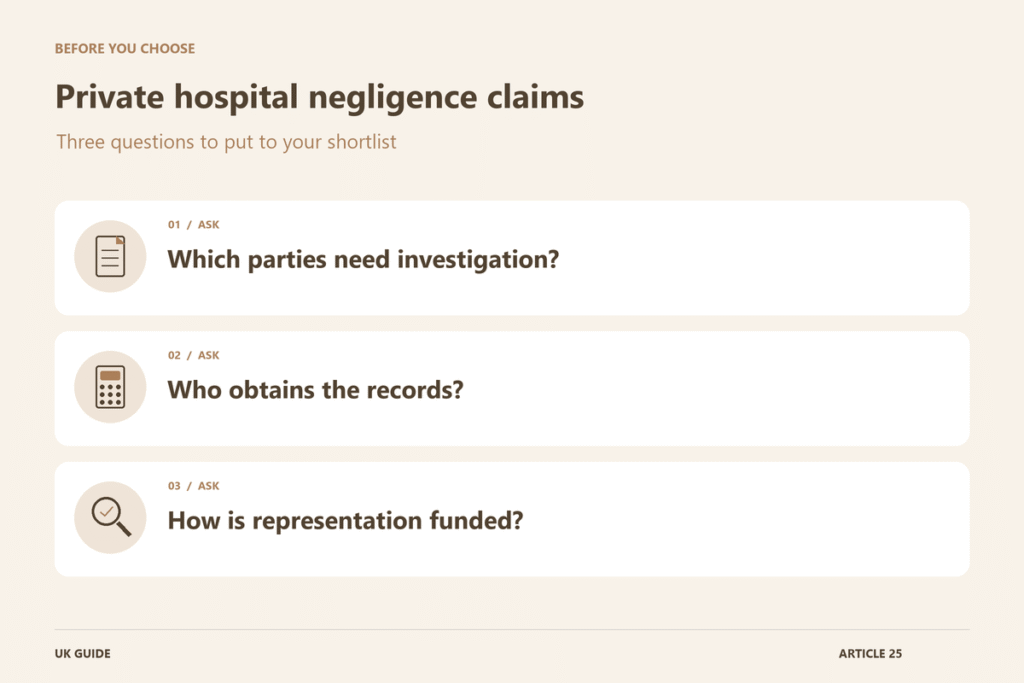
Questions to put to your shortlist
- Which parties need investigation?
- Who obtains the records?
- How is representation funded?
A point that is easy to miss
A private treatment package may involve several organisations or professionals. Ask the solicitor to assess the documents before assuming that a single company is responsible for every aspect of care.
Put the comparison into practice
Make a list of the organisations and professionals named in your consultation letters, consent material, invoices and correspondence. Give that list to the solicitor as information to investigate rather than as a conclusion about responsibility. Ask how the team would establish the relevant roles and which records it would need from each source.
Compare the proposed legal scope with any ongoing complaint or communication process. Ask whether the firm would advise on those interactions, handle them directly or treat them as outside the engagement. Keep treatment questions with the appropriate clinicians and ask the solicitor to explain its separate role. A clear division of responsibility helps you understand the service being offered without assuming that a hospital package, a brand name or an initial complaint response resolves the underlying legal assessment.
Make the final decision from the written offer
Request a proposal that reflects the circumstances you actually discussed. Check the name of the contracting organisation, the work included, the charging basis and the person responsible for answering questions. Resolve any important difference between the conversation and the documents before proceeding. Keep a dated copy of the version you accept. If an essential assumption remains uncertain, ask what evidence would settle it and how that uncertainty could affect your next step.
Further reading
Related reading
- Clinical Negligence Solicitors: Comparing Fees, Funding and Experience (UK)
- Birth Injury Law Firms: What Families Should Compare Before Hiring (USA)
- Medical Malpractice Attorney Fees: Expert Witness Costs and Legal Expenses (USA)
- How to Choose a Medical Malpractice Lawyer (USA)
Explore more in Medical Malpractice and Clinical Negligence.