Compare business credit cards against your actual spending and repayment pattern. Rewards are only one part of the decision; fees and interest can change the overall result. Ask how eligibility, guarantees and account management work before relying on an advertised offer.
The decision this article helps you make
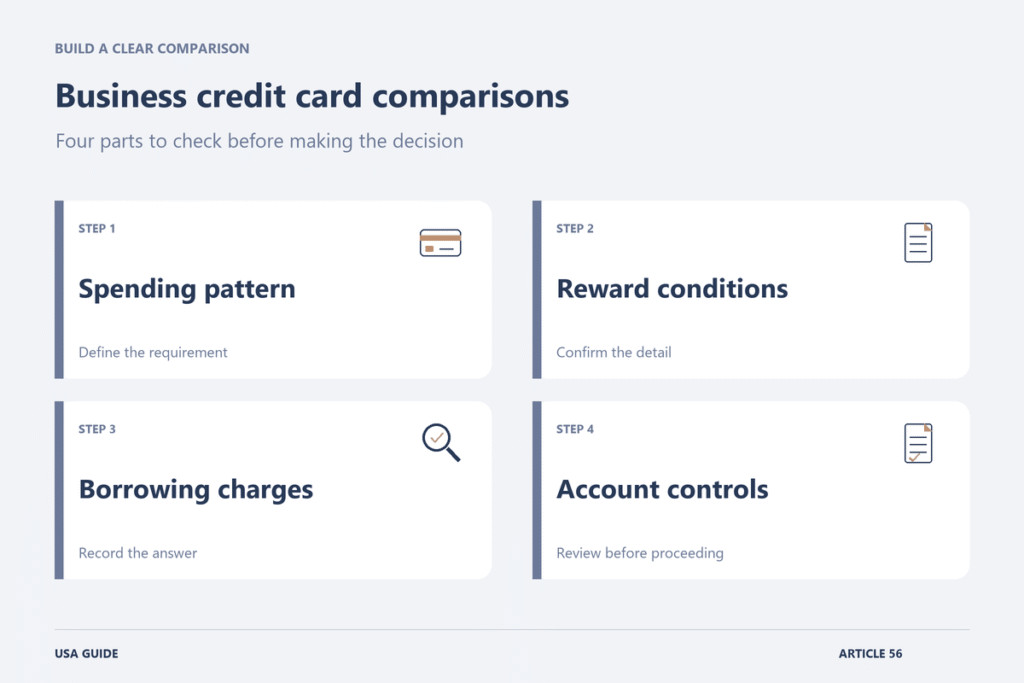
Estimate rewards using relevant spending categories and compare them with recurring charges. Assess the cost of carrying a balance separately rather than assuming that points will compensate for borrowing costs.

Start with the transactions you actually expect
List the balance, spending or banking activity the product is intended to support. For a business account, include payment types, currencies, cash handling and the people who need access. For credit, identify expected repayment and any promotional period. A reward or introductory offer can be attractive without matching the way you will use the account after the initial period ends.
Convert the fee schedule into a realistic comparison
Ask about recurring charges, transaction fees, interest, transfers and services you may need occasionally. Check the conditions for a promotional benefit and what pricing applies when it ends. Use your expected activity to estimate relevant costs, labelling assumptions clearly. An account described as free may still charge for particular transactions, and a card with an annual fee may or may not justify that cost for your usage.
Understand the provider and the account structure
Identify the legal entity supplying the product and ask which account protections apply to that structure. Do not assume that every financial app operates as a bank or holds money in the same way. Verify relevant details independently and ask how access, fraud reporting and complaints would be handled. For business users, confirm permission controls and how access would be removed when an employee leaves.
Check the transition and the exit
Ask what happens when an introductory offer expires, an account is closed or a balance remains after a promotional period. If you are switching, identify payments and records that need attention before the previous arrangement ends. Save the pricing document and eligibility conditions. The final choice should suit normal use and a less favourable scenario, not simply the best possible interpretation of a bonus or rewards headline.
Compare the alternatives on the same basis
Choose the decision criteria before looking at promotional claims. Write down the outcome you need, the constraints you cannot change and the circumstances that would make an option unsuitable. Send the same basic requirements to each organisation. Otherwise, you may spend time comparing answers to different questions. A short comparison with clear assumptions is more useful than a long list of features that do not affect your decision.
Separate confirmed information from impressions. Written scope, disclosed charges and an identified delivery team belong in the first group. A persuasive conversation or an attractive website belongs in the second. Both can influence your experience, but they should not carry the same weight. Where an answer is missing, leave a visible gap rather than filling it with an optimistic assumption. Ask a follow-up question that could resolve the uncertainty.
Finally, test your preferred option against a plausible difficulty: a delay, a change in scope, an unavailable contact or an unexpected additional cost. Ask how the agreement would handle that situation. This can reveal important differences that a simple price ranking hides. Choose the option whose commitments and limitations you understand, and record why it fits your needs. If the essential information is still missing, improve the comparison before treating the shortlist as a final decision.
Apply the comparison to your location
Use the state relevant to your situation when checking a provider’s qualifications and the terms of an offer. A national advertisement does not establish that the advertised service is available on the same terms where you live. Record the legal name of the organisation you would contract with, the office responsible for delivery and the date of its proposal. Ask which state-specific conditions affect your comparison. Keep personal identifiers out of initial comparison emails; use a verified secure channel when supporting documents are actually needed.
Questions to put to your shortlist
- What annual fees apply?
- Which purchases earn rewards?
- Are personal obligations involved?
A point that is easy to miss
A card suited to paying in full may be unsuitable for carrying debt. Compare the borrowing terms directly instead of using a reward calculation as the whole assessment.
Put the comparison into practice
Build two separate comparisons: one for paying the card balance in full and another for carrying debt. In the first, estimate relevant rewards from your actual spending and subtract fees. In the second, examine the borrowing charges and repayment implications directly. Combining the two can make an unsuitable borrowing product appear attractive because the rewards are easier to picture.
Ask about eligibility, guarantees, staff cards and controls over spending. Check how points or cash rewards are earned, restricted and redeemed, including what happens when the account changes or closes. Do not assume every purchase qualifies at the promoted rate. A sign-up offer should be valued only if the business can meet its conditions through appropriate existing spending, without adding unnecessary expenditure just to reach a promotional target.
Make the final decision from the written offer
Request a proposal that reflects the circumstances you actually discussed. Check the name of the contracting organisation, the work included, the charging basis and the person responsible for answering questions. Resolve any important difference between the conversation and the documents before proceeding. Keep a dated copy of the version you accept. If an essential assumption remains uncertain, ask what evidence would settle it and how that uncertainty could affect your next step.
Further reading
Related reading
- Balance Transfer Credit Cards: Comparing Fees and Promotional Offers (USA)
- Business Checking Accounts: Comparing Fees, Bonuses and Cash Deposit Limits (USA)
- Business Bank Accounts for Limited Companies: Comparing Charges and Features (UK)
- Balance Transfer Credit Cards: Comparing Transfer Fees and Promotional Periods (UK)
Explore more in Credit and Banking.